


Three of Ghana’s state-owned enterprises employed more than half of the workforce across the country’s state enterprise sector in 2025, highlighting the concentration of public jobs in a handful of institutions as the government seeks to contain spending.
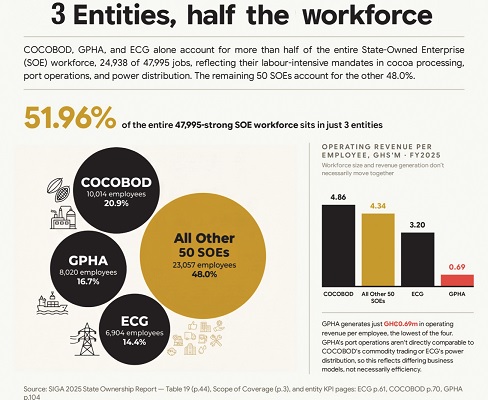
The cocoa regulator COCOBOD, the Ghana Ports and Harbours Authority (GPHA) and electricity distributor ECG together employed 24,938 people, representing 51.9 per cent of the 47,995 workers recorded across the state-owned enterprise portfolio, according to data from the State Interests and Governance Authority (SIGA).
The concentration is striking because the three institutions also differ sharply in their ability to generate revenue and sustain their finances.
COCOBOD, the country's largest state enterprise employer, had 10,014 workers, followed by the GPHA with 8,020 and the ECG with 6,904.
The remaining 50 state-owned enterprises in the dataset employed 23,057 people combined, averaging fewer than 500 workers per entity.
“The skew is not new to Ghana's public enterprise landscape, but the scale illustrated by the latest figures is striking,” said the founder and lead trainer at the International Data and Research Agency, Finex Skills Hub, Bernard Obeng Boateng.
“Fewer than six per cent of the entities captured in the data employ more than half of their workers.”
The figures come as the country tries to rein in public spending and improve the financial performance of state-owned enterprises, many of which have relied on government support despite their commercial mandates.
Jobs do not equal returns
The data showed that the size of an SOE's workforce did not necessarily translate into higher revenue.
COCOBOD generated operating revenue of about GH¢4.86 million per employee in 2025, the highest among the groups compared.
The 50 other SOEs averaged about GH¢4.34 million per employee, while ECG generated about GH¢3.20 million.
The GPHA, despite being the second-largest employer, generated only about GH¢690,000 per employee, the lowest of the four groups.
The differences, however, do not provide a straightforward measure of efficiency.
Global cocoa prices and export volumes heavily influence COCOBOD's revenues, while the GPHA's earnings depend on port charges and cargo throughput and its operations require heavy investment in infrastructure.
ECG's financial performance is affected by regulated tariffs, electricity collection rates, distribution losses and the cost of power purchases.
The workforce concentration also partly reflects the different mandates of the three institutions.
COCOBOD operates across the country’s cocoa-growing regions and requires staff for extension services, quality control, procurement, and warehousing.
The GPHA operates the country's major ports at Tema and Takoradi, while ECG maintains electricity distribution infrastructure across the country.
Many other SOEs are smaller agencies, holding companies, or specialised institutions whose mandates require fewer employees.
ECG's financial burden
The disparity becomes more significant when workforce figures are viewed alongside the financial condition of the companies.
Ghana's state-owned enterprise sector generated GH¢176.43 billion in revenue in 2025, up 28.12 per cent from GH¢137.64 billion a year earlier, according to SIGA's 2025 State Ownership Report.
Net profit after tax swung to a GH¢19.80 billion gain from a GH¢2.25 billion loss in 2024.
But the sector-wide improvement masked persistent weaknesses among some of its largest employers.
SIGA said five SOEs, including ECG, recorded losses in every year from 2021 to 2025.
ECG's liabilities stood at GH¢82.31 billion in 2025, accounting for almost 30 per cent of the GH¢281.99 billion in total liabilities across the SOE sector.
That makes ECG's position particularly significant: it was one of the country's three largest state employers but generated considerably less revenue per employee than COCOBOD and the wider group of smaller SOEs, while carrying a disproportionately large share of sector liabilities.
The utility service provider has for years faced distribution losses, weak revenue collection and arrears owed by government institutions, problems that successive administrations and international lenders have sought to address through reforms.
Beyond headcount
SIGA's report covered 162 state-related entities, comprising 53 SOEs, 36 joint venture companies and 73 other state entities.
The authority said the report was intended to improve accountability, capital allocation and sustainable value creation across the state portfolio.
For policymakers, analysts said the figures raise a broader question: whether the concentration of public employment in a small number of state companies is matched by their financial and operational performance.
They said decisions on staffing, subsidies and capital investment should take account of each entity's mandate, labour costs, profitability, capital intensity and public-service obligations rather than relying on headcount or revenue alone.
For Ghana, the challenge is, therefore, not simply the number of people employed by state enterprises, but whether the institutions carrying the largest public payrolls are generating enough economic and public value to justify their scale.