

African cinema needs stronger African audiences. And at BSIFF, we have been wondering whether language might be one of the bridges back to them.Because here is the thing. We are making films.
More filmmakers are emerging. Technology is making production easier. Our films are travelling. We are appearing at festivals around the world. Streaming has opened doors that did not exist before.
All of this is happening. But there is a question we keep coming back to: Are Africans watching African films?
Not occasionally. Not because somebody sent them a link. Not because an African film happened to appear on a streaming platform. We mean watching them deliberately. Looking for them. Paying for them. Going to the cinema for them. Talking about them. Arguing about them. Waiting for the next one.
Because we can make all the films in the world, but if we don’t build an audience for them, what exactly are we building? And somewhere inside that question, we kept coming back to language. Could telling more of our stories in the languages our people actually speak bring our cinema closer to them?
We don’t know that language is the answer. It can’t be. There are too many other things that need fixing. But we think it is a question worth asking. And when you start looking around, there are clues everywhere.
What is happening around the world?
Look at what is happening around the world. Look at South Korea.Korean films and series have travelled extraordinarily far without first becoming English. They remain Korean. The language is Korean. The food is Korean. The names are Korean. The culture is Korean.
And somehow, millions of people who do not speak Korean are watching. They read subtitles. They listen to dubbed versions. They enter the story. China gives us another fascinating example. In 2026, the Mandarin-language historical series Pursuit of Jade crossed 4 billion effective online plays and became one of the year’s major television phenomena. And then it travelled.
It was released internationally with subtitles in 14 languages and five dubbing options, reaching audiences across 191 countries and regions. It also entered Netflix’s weekly Global Top 10 for non-English television.
Now, this is interesting to us. Because the producers didn’t say: if we want the world to watch this, perhaps we should make it in English. They made it in Mandarin.
They kept the language of the story and translated access to it. What if we separated those two things in African cinema too?
Instead of asking: What language should I make this film in so that everybody can understand it?
What if we asked: What language does this story belong in?
And then: How do I make sure everybody else can enter it?
Those are two completely different problems. And once we started thinking about it that way, another thought appeared: The language of the story does not have to be the language of the market.
But then again, why are we looking all the way to Korea and China? We have already seen something happen right here at home.
Ghanaian broadcasting already ran this experiment
Turn on Ghanaian radio. Turn on Ghanaian television. Listen. Twi and other Ghanaian languages sit comfortably in the mainstream.
We discuss politics in them. Relationships, Religion, Entertainment, News, Comedy, Everything. And people watch. People listen, People call in, People participate.
At some point, Ghanaian broadcasting figured out something very important. You could meet the audience where they were. And then we did something even more fascinating.
We took other people’s stories and brought them closer to ourselves. Think about all those Mexican and Indian soaps and series that found audiences in Ghana over the years.
The characters were not Ghanaian. The stories were not Ghanaian. The languages were not Ghanaian. Some of these stories came from thousands of kilometres away.
And what did Ghanaian broadcasters do? They dubbed them. They subtitled them. They localised them.
And suddenly people were following these characters, discussing what happened, waiting for the next episode. Foreign stories became part of everyday Ghanaian popular conversation.
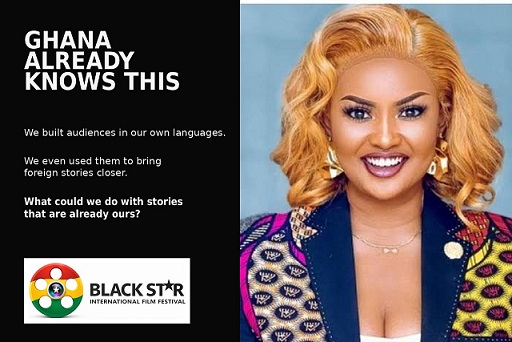
Language had shortened the distance. So naturally, we started asking ourselves: If we could use our languages to bring other people’s stories closer to us, what could we do with stories that are already ours? Hmm.
Maybe language is also business
We tend to talk about indigenous language in terms of culture. Preservation. Identity. Heritage. Of course, our languages carry all of that.
They carry humour. Memory. History. Worldview. Ways of saying things that sometimes simply refuse to survive translation.
But what if language is also an audience question? Could somebody who doesn’t currently think cinema is for them feel differently when the people on the screen sound like them?
Could hearing your own language reduce that invisible distance between you and the film? Could it make the story feel closer? And if it does, what happens when you multiply that person by a thousand?
A hundred thousand? A million? Because now we are no longer talking only about culture.
We are talking about business. Audiences buy tickets. Audiences subscribe. Audiences attract advertisers. Audiences create demand. Demand attracts investment. Investment makes more films possible. So perhaps language is not only a creative decision. It can also be part of an audience strategy.
And then we hit another question: quality
Because we have to be careful here. If local language were enough by itself, Ghana would already have solved this problem. We haven’t.
And Kumawood is actually a fascinating place to look. Kumawood proved something.
It proved that people would watch. Films predominantly in Twi built stars, created a screen culture and found audiences who recognised themselves in what they were watching.
That is not a small achievement. But then comes the next question. How do you scale it?
How does that film move from Kumasi to Accra? From Ghana to Uganda?
From Africa to the world? And that brings us straight into the quality conversation. Korea’s success is not simply because Koreans make films in Korean.
China’s success is not simply because Chinese filmmakers make films in Mandarin. Look at what surrounds the story. Writing. Directing. Performance. Cinematography. Sound. Production design. Post-production. Technology. Marketing. Distribution.
Years of investment in people and infrastructure. The language remained local. The ambition for the quality did not.
And this is where African cinema has work to do. Because people may come because they recognise themselves. But they will stay because the storytelling is good.
They will pay because what they are receiving is worth paying for. And someone thousands of kilometres away will read subtitles for two hours because whatever is on the other side of those subtitles is worth their time.
So when we talk about the future of Kumawood, for example, we are not talking about removing what made Kumawood work.
Why would we? The language worked. The humour worked. The familiarity worked. The stars worked. The audience connection worked. The question is what happens when we add more. More investment in craft. More technology. Stronger production. Better sound.
Better distribution. Bigger ambition.
What happens when we take what already connected with the audience and give it everything it needs to scale? Now that becomes interesting.
And perhaps that is one of the lessons we can take from Korea and China. Not that we should become Korea.
Not that we should become China. But that cultural confidence and world-class ambition can live in the same house. We don’t have to become less African to become better.
And no, this is not about getting rid of English
An English-language Ghanaian film is Ghanaian cinema. A Twi film is Ghanaian cinema.
A Ga film is Ghanaian cinema.
An Ewe film is Ghanaian cinema.
A Dagbani film is Ghanaian cinema.
A Fante film is Ghanaian cinema.
There is room.
We are not interested in replacing one restriction with another. The question is whether all these languages have been given the possibility to exist, grow and find their audiences.
Because the world has already shown us something else.
People will watch stories in languages they do not understand.
They do it every day.
So maybe the filmmaker should be free to ask:
What language allows me to tell this story most truthfully?
And then we solve the second problem:
How do we invite everybody else in?
Subtitle it.
Dub it.
Translate it.
Use technology.
Build distribution.
Tell the story in the language where it lives. Then build the doors through which everybody else can enter.
And Then There is Africa
This one fascinates us.
When we talk about our films travelling, why is our imagination almost always:
Africa to Europe.
Africa to America.
Africa to Asia.
What about: Ghana to Uganda? Uganda to Ghana? Senegal to Nigeria? Nigeria to Kenya?
Why shouldn’t somebody sitting in Kumasi fall in love with a film made in Luganda? Why shouldn’t somebody in Kampala be waiting for the next great Twi film?
Perhaps dubbing and subtitling are not only tools for taking Africa to the world. They could become part of the infrastructure through which Africans discover one another.
Now imagine that. A filmmaker tells the story in the language where it naturally lives.
The film is subtitled.
Dubbed.
Translated.
Distributed.
And it moves.
Across Ghana.
Across Africa.
Across the world.
Suddenly, local language does not necessarily make the market smaller. The story can remain local while the market becomes global.
So Why is this a BSIFF 2026 pillar?
Because we think African cinema has to start asking these questions.
The 11th Black Star International Film Festival takes place from 24–27 September 2026 at Golden Eagle Cinemas in Kumasi, under the theme:
“Film & Global Culture: The New Wave of African Cinema.”
And when we ask ourselves what this new wave of African cinema might look like, we keep coming back to the audience.
Not only the audience in London.
Or New York.
Or Paris.
Or Seoul.
The audience in Kumasi.
The audience in Accra.
Lagos.
Kampala.
Dakar.
Nairobi.
The African audience.
Language will not solve everything.
We still have to deal with quality.
Distribution.
Affordability.
Cinema infrastructure.
Marketing.
Technology.
Investment.
But we want language firmly inside that conversation. Because Ghanaian broadcasting has already shown us something. Kumawood has already shown us something. Korea and China are showing us something. And maybe we should pay attention.
For us, the proposition is becoming clearer:
Build the audience at home.
Raise the quality of the work.
Create the infrastructure for it to travel.
Tell our stories without being afraid of sounding like ourselves. Make them good enough that somebody else wants to enter.
And then give them the doors.
Rooted at home.
Confident in who we are.
Committed to excellence.
Open to the world.
Perhaps bringing African cinema closer to the world begins with bringing it closer to its own people.
Source: Black Star International Film Festival
