
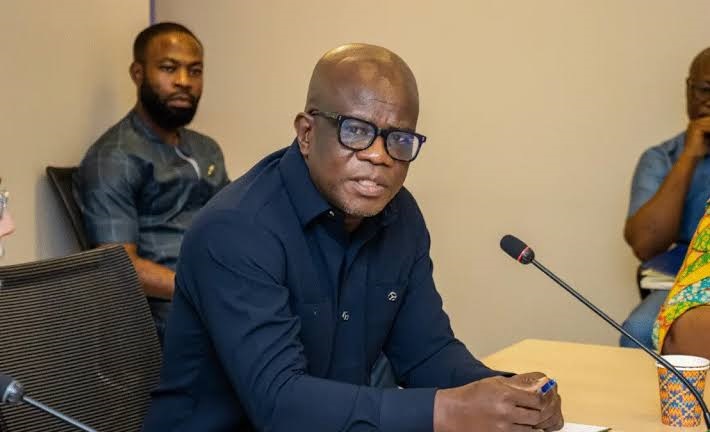
The Director-General of the State Interests and Governance Authority (SIGA), Professor Michael Kpessa-Whyte, has said the responsibility for addressing the debt burden of loss-making state-owned enterprises (SOEs) lies with the Ministry of Finance and the respective sector ministers.
He said SIGA’s role was to provide oversight at the aggregate and sectoral levels rather than prescribe solutions for the financial problems of individual state enterprises.
Professor Kpessa-Whyte said this in a radio interview monitored by Graphic Online on Joy FM on Monday [August 31, 2026].
He was speaking after SIGA released its 2025 State Ownership Report (SOR), which shows that the total liabilities of SOEs stood at GH¢281.99 billion, with the Electricity Company of Ghana (ECG) accounting for GH¢82.31 billion.
Professor Kpessa-Whyte said the debt burden required policy decisions by the appropriate ministries.
“This is something that falls directly within the context of the sector minister, the Minister for Finance and, of course, the respective sector ministers,” he said.
“This has to be dealt with at a level of policy,” he added.
Asked how the debt burden should be addressed, Professor Kpessa-Whyte said the solution would depend on the circumstances of each state enterprise.
“Some of them may need to be supported by way of bailouts. Others may need to be restructured. Others may need a governance reform so as to be able to reduce their debt. Others may simply have to check their spending again,” he said.
“You don’t owe a lot and spend a lot at the same time,” he added.
Professor Kpessa-Whyte cited ECG as an example of a state enterprise which had exercised restraint in its spending.
“I know ECG, in particular, has been relatively prudent with its spending. And it is not surprising that we have seen that they have been able to minimise their debt portfolio,” he said.
Read also: State-owned Enterprises (SOEs) increased revenue in 2025 by 28.1 per cent to GH¢176.4 billion
SIGA’s role
Explaining SIGA’s role in dealing with the financial challenges of state enterprises, Professor Kpessa-Whyte said the Authority did not want to speak on behalf of individual entities.
“What we don’t want to do at SIGA is to speak for each of the entities directly, but to remain at the aggregate and then the sectoral level,” he said.
The State Ownership Report showed that total SOE liabilities fell by 4.31 per cent year on year.
Despite the fall in total liabilities, five state enterprises, namely ECG, Ghana Cylinder Manufacturing Company, GNPA, Graphic Communications Group Company and Ghana Digital Centre, recorded losses in every financial year from 2021 to 2025.
The report also showed that six entities, including AirtelTigo Ghana, Gihoc Distilleries and Tema Oil Refinery, recorded negative equity throughout the same period.
SIGA said the financial position of some state enterprises required stronger accountability and more disciplined use of capital.
It also called for action to be taken on entities which have continued to underperform.
The Authority said the gains recorded in the 2025 financial year “must not become a temporary rebound.”
