

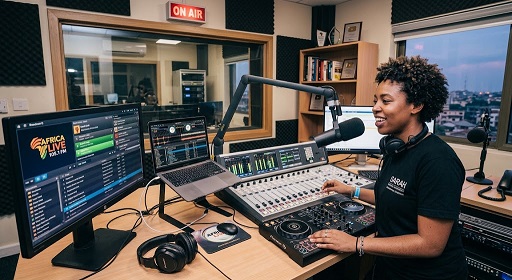
THERE was a time when getting a song into the Ghanaian mainstream felt like trying to enter an exclusive nightclub.
First, the record label or producer had to believe in you. Then came the radio station. Then the DJ. If the DJ liked your song, the audience might hear it. If the audience liked it, the song had a chance of becoming a hit.
The formula was simple: Record Label/Producer → Radio → DJ → Audience.
It was not perfect. It was certainly not always fair. But at least you knew where the door was, and more importantly, who was standing in front of it.
Today, that door has been blown off its hinges.
A song can emerge from a bedroom studio, catch fire on TikTok, travel through WhatsApp, rack up YouTube views, generate streams and arrive at a radio station already wearing the crown.
The new route can look more like: TikTok → WhatsApp → YouTube → Streaming → Radio.
Suddenly, the DJ is not necessarily the person who introduces the hit. Sometimes, the DJ is the person discovering that the hit has already happened. That is a remarkable shift in power, and Ghana is right in the middle of it.
The DJ Has Lost Some Power, But Not All of It
Radio is far from dead. It remains a powerful force in Ghana's music ecosystem, offering reach, personality, conversation and cultural context. But the DJ's once dominant role as the gatekeeper has been disrupted.
Today, a song can build momentum on TikTok, spread through WhatsApp, gain visual traction on YouTube and accumulate streams before it ever reaches a radio studio.
By the time the DJ presses play, the audience may already be demanding the song. The revolution is that listeners are no longer simply consuming music, they are increasingly helping decide what deserves attention.
Welcome to the Attention Economy
Here is where things get really interesting: the modern music business is no longer simply selling songs, it is selling attention. Streams, views, TikTok creations, YouTube watch time, radio spins, playlist placements and influencer mentions have all become currencies in the race to create a hit.
The question is no longer just, "Is the song good?" but increasingly, "How much attention can this song generate?" A hit is now measured by numbers: streams, views, shares, playlists, radio rotations, searches and how many people are using the sound.
In this new attention economy, the numbers can become the story, and sometimes, the story itself can create the numbers.
When Popularity Can Be Manufactured
This is where the industry needs to be careful.
Digital platforms have democratised access, but they have also created new opportunities to manufacture momentum.
Payola did not disappear because the internet arrived. It simply acquired new cousins.
Yesterday, the conversation was largely about paying for radio exposure.
Today, the ecosystem can involve paid playlist placements, influencer campaigns, sponsored content, artificial streams, fake views and manufactured engagement designed to make a record appear hotter than it really is.
The objective is familiar: create the appearance of demand and hope that appearance produces genuine demand.
It is the musical equivalent of putting a queue outside an empty restaurant.
The problem is not promotion. Artistes have always promoted their music. The problem arises when the line between legitimate marketing and manufactured popularity becomes blurred.
The digital era has therefore not killed gatekeeping.
It has multiplied the gatekeepers.
And some of them do not have faces.
The Algorithm is in the Room
There is another gatekeeper in town, and this one never sleeps: the algorithm. It watches what people click, skip, replay, share and stream, using that behaviour to decide what they might want to hear next.
For independent artistes, this can be liberating, giving unknown musicians a chance to break through without a major label, powerful connections or influential radio personality. The right song, the right content and the right moment can create momentum from almost anywhere.
But there is a catch: algorithms reward measurable behaviour, and where there are numbers, there is always the temptation to manipulate them.
The new system, therefore, has not necessarily eliminated gatekeeping or made it more democratic. It has simply changed its form. The old gatekeeper had a face. The new one has a dashboard.
So, Who Really Makes a Hit?
Perhaps, the most honest answer is that nobody makes a hit alone anymore. The artiste creates the music, the audience creates the momentum, influencers generate conversation, algorithms amplify behaviour, playlist curators drive discovery, DJs provide cultural context and credibility, while radio delivers mass exposure.
But the real test is what happens when the attention turns into money. Ghana's music industry faces the curious contradiction of songs being everywhere while the people who created them struggle to convert popularity into sustainable income. A million views may generate excitement, but visibility is not the same as value, and virality does not automatically translate into royalties or ownership.
The more important questions, therefore, are not simply how many people saw or streamed the song, but who owns the recording and publishing, who collects the royalties, who paid for the promotion, how much of the engagement was genuine, and ultimately, who made money from all that attention?
Radio Still Has Something the Algorithm Does Not
For all the disruption, radio still holds one powerful advantage: human judgment. A good DJ does more than press play. They understand the mood of a city, the pulse of culture, the right moment to introduce a record and when an emerging artiste deserves that crucial first break. An algorithm can recommend a song, but a DJ can give it context, personality and meaning.
Yet today's DJ must also recognise that the audience now carries its own remote control and is no longer waiting for permission to decide what it wants to hear.
Gatekeeping has not disappeared; it has simply become more decentralised, commercialised and data-driven, with the battle for Ghana's next big hit now playing out across TikTok, WhatsApp, YouTube, streaming platforms, playlists, influencers and algorithms.
The old industry asked, "Who will play the song?" The new industry asks, "Who can capture attention, sustain it, turn it into a hit and ultimately get paid for it?"
This is because in today's music business, getting heard is only half the game. The real power lies in knowing who controls the attention once everybody starts listening.
