
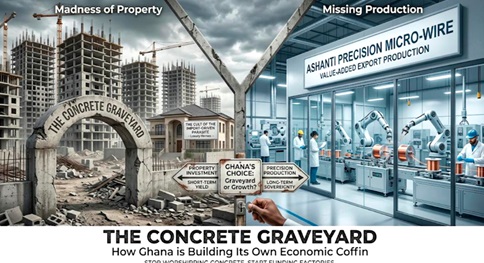
In the sweltering heat of Accra, the skyline is changing.
Cranes pierce the horizon, and every square inch of available earth is being suffocated by concrete.
We call it "development." The banks call it a "portfolio." I call it a national suicide note written in mortar and bricks.
We are currently living through the most magnificent, expensive, and devastating delusion in our nation’s history.
Across Ghana, the highest aspiration of the citizen, from the ambitious civil servant to the successful trader, is to erect a "big house" or a commercial property.
It is the ultimate status symbol, the tangible proof of "having arrived."
Yet, while we compete to see who can build the most ostentatious mansion, we are systematically ignoring the only thing that actually keeps a nation alive in the 21st century: value-added, precision production.
The cult of the import-driven parasite
Look at our economy and be ashamed. We are an import-driven society, a nation of middlemen, shopkeepers and consumers.
We do not manufacture; we facilitate the consumption of what others have produced.
We have perfected the art of the trade margin, taking a cut of products manufactured in Asia or the West, selling them to our own people, and then rushing to the bank to deposit the proceeds into more real estate.
This is the great Ghanaian "Madness of Property."
Our financial institutions, those lazy, risk-averse entities, are the primary enablers of this decay.
They adore real estate. A building is static; it is collateral that can be measured, touched and seized. But look at their appetite for industrial credit.
Ask a Ghanaian bank for a long-term, low-interest loan to establish a precision metallurgical plant that produces 25-micrometre micro-wires for the global semiconductor supply chain, and you will be met with blank stares, scepticism, and high-interest rates that make failure a mathematical certainty.
They do not want to fund the machines that build the future.
They want to fund the walls that house the present. In doing so, they are actively starving our industrial base to feed a speculative property bubble that creates zero export value.
The illusion of the 4-year saviour
We are a nation obsessed with the four-year electoral cycle.
We treat the democratic calendar like a religious decree, believing that if we just vote for the "right" person, the power of the state will magically manifest factories and prosperity.
This is the most dangerous illusion of all.
No government in a short-term, 4-8 year window can "win" power in a way that generates deep industrial sovereignty.
Real industrial power is not a campaign promise; it is a 50-year commitment.
It is the boring, unglamorous work of securing power infrastructure, training thousands of technicians to work within sub-micron tolerances, and establishing the supply chains that connect a workshop in Kumasi or Tema to the global markets of the North and the East.
While our leaders focus on the next election, they ignore the matrix of the global financial architecture ruled by the military fiat currencies of the superpowers.
These currencies are not earned by building luxury apartments in East Legon.
They are earned by precision, by quality, and by the sheer, unyielding ability to produce components that the rest of the world cannot do without.
Every dollar spent on a speculative luxury apartment is a dollar not spent on a CNC machine, a laser-cutter, or a cleanroom.
We are trading our future for a facade.
The shame of the local elite
There is a profound, festering shame in the fact that our local elite, the people who command the most capital, are the least interested in building production lines.
When you walk through a high-tech facility in the West or in mainland China, you see precision.
You see the cold, hard logic of efficiency.
You see people who understand that wealth is not found in a house, but in the output of the assembly line.
In Ghana, we respect the car.
We respect the gated community.
We respect the lifestyle of the merchant who imports finished goods.
But we treat the builder of production lines as a dreamer, or worse, a fool.
We are 95 per cent import-driven, and we wear that vvvvdependency like a badge of honour, disguised as "market accessibility."
The call to build, not occupy
We must stop worshipping the dead weight of real estate and start worshipping the kinetic energy of the factory.
If we do not pivot now, we will wake up in twenty years in a country filled with beautiful, empty, and decaying concrete shells, while our neighbours, those who chose to master the machine, will be the ones dictating the terms of our economic existence.
The financial sector must be forced, either by policy or by the rise of new institutional frameworks such as the Ashanti Financial Protocols, to stop financing this property madness and start financing the sovereign industrial capacity of this nation.
We are currently building our own graveyard, brick by expensive brick.
It is time to tear down the scaffolding of our vanity and start building the production lines that will actually earn our place in the global order.
We have spent enough time being the world's consumers. It is time, finally, to become its producers.
Anything less is not governance; it is merely an elaborate arrangement of deck chairs on a sinking ship, made of the finest cement money can buy.
