
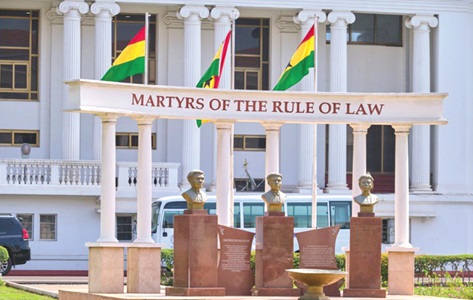
Three eminent long-time members of political parties experienced their Damascus Road moment and asked the Supreme Court (SC) to declare the delegate system of their parties as unconstitutional.
The plaintiffs were Prof. Frimpong-Boateng, Dr Nyaho-Tamakloe and Dr Christine Amoako-Nuamah.
The defendants were the Convention People’s Party (CPP), the National Democratic Congress (NDC), the New Patriotic Party (NPP), the EC and the Attorney-General (A-G).
The plaintiffs have prevailed.
The plaintiffs’ victory means that political parties must now allow ‘all party members in good standing’ to vote in their internal party elections.
There are risks and implications associated with the political parties using a non-delegate system to select party officers and candidates for Parliament and the presidency.
I discuss these risks and political implications below.
Risk of infiltration
The delegate system, which the suit opposed, gave a political party some assurance that its electoral college was composed of committed and loyal members.
In a non-delegate system, a political party's internal election becomes susceptible to infiltration and corruption by outsiders who do not wish it well.
How will this happen?
Simple. The opposition party arms its operatives with money and directs them to recruit voters for the target party.
These operatives will buy membership cards and pay dues for ‘members’ so that they instantly become members ‘in good standing.’
These members are then directed to vote for the weaker candidate for office in the target party.
The NDC introduced a version of this open primary system for the 2016 elections.
The NDC did a quick sankofa; they returned to the delegate system for the 2020 and subsequent elections.
Marginalisation, rural communities
The SC’s ruling will further marginalise rural communities and provide fuel to irredentist forces.
How will this work? Simple. A candidate for national political party office can win primaries by recruiting a few hundred thousand voters from the densely populated cities of Accra-Tema, Kumasi and Sekondi-Takoradi.
The candidate will not find it convenient or profitable to canvass for votes in ‘far’ places such as Hohoe, Lawra or Bongo.
This same phenomenon will manifest in sub-national elections such as regional and constituency primaries.
In poor communities, buying membership cards and paying party dues compete with the food budget. Obtaining party ‘membership in good standing’ is a luxury the rural poor cannot afford.
Based on the Ghanaian political principle of ‘let’s take care of the people who brought us to power,’ these rural communities will continually suffer economic neglect.
In time, they will ask, ‘Are we part of Ghana?’
ADS is not a panacea for the monetisation of politics.
Opponents of the delegate system have argued that expanding the Electoral College to all ‘members in good standing’ will reduce the influence of money in primaries. Really?
Have we so soon forgotten the spectacle of people looting warehouses for goods that remained undistributed after the last general election?
If money and goods are distributed to voters who number in the millions during the general election, what mind-altering beverage makes anyone think that eliminating the delegate system will reduce the influence of money?
The sad reality is that those with money largely run the politics of every country.
There is no cure for the monetisation of politics, no matter how much our idealism will war against it. Some have suggested state funding of political parties.
But this will be a misuse of public funds in an environment of financial stringency.
It is a false claim that a delegate system is not democratic. Many countries use a delegate system in primaries or to elect party officers.
No one has accused these countries of not being democratic.
The plaintiffs have sought to fix a machine that is not broken. It has been said that ‘if it ain’t broke, don’t fix it.’
The members of the NDC, NPP and CPP have not massed up in our streets in indignation, demanding the abolition of their party’s delegate system.
The unspoken message of the suit and the ruling is that party members, being unsophisticated, are unaware that their rights are being trampled upon.
Hence, white-hatted cowboys to the rescue.
Our political parties have internal mechanisms that allow them to switch from a delegate system to an open system if a majority of their members wishes it.
Constraint: independence of private voluntary associations
It is now established that although political parties are private voluntary associations, they are not free to determine their own governance.
Increased cost of internal party elections.
Finally, the expansion of the electoral college demanded by the SC will increase the cost of running internal elections.
More polling areas, ballot papers, voting paraphernalia, security, etc must now be provided.
Fellow Ghanaians, we have now placed ourselves firmly on the path to democratic perdition…unless we rouse ourselves from our political stupor and reaffirm that after all, we are capable of managing our own affairs.
The writer is a former deputy minister of state/senior lecturer at GIMPA and vice-president of the Ghana Association of Writers. He is an author.
