
Work on the reconstruction of the Accra-Tema Motorway and extension project is currently 50 per cent complete, a consultant on the project has stated.
The Chief Executive Officer (CEO) of Associated Consultant Ltd, Kwabena Bempong, said on completion, the major road infrastructure, designed to last 25 years, would be a 10-lane dual carriageway with three-lane urban highway on either side of the existing Motorway.
The two inner lanes on either side of the road will retain the concrete form of the original motorway, with the three new lanes being constructed on the outer side having asphalt surface.
The project comprises 19.5-km Tema to Tetteh Quarshie stretch; a continuation of 5.7-km stretch from the Tetteh Quarshie Interchange to Apenkwa Interchange, and then a 2.5-km section from Tesano to the Neoplan Station at the Kwame Nkrumah Circle Interchange.
Mr Bempong said “since the road will be a 10-lane dual carriageway, there will be 10 footbridges that will be constructed at strategic locations to ease crossing”.
The projects are currently being implemented by the Maripoma Enterprise Limited.
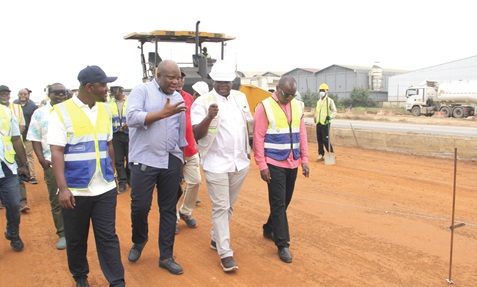
Mr Bempong disclosed these when the Minister of Roads and Highways, Governs Kwame Agbodza, last Wednesday inspected the progress of work on the redesigned Accra-Tema Motorway and extensions project, and the construction of section one of the Tema Roundabout to Tetteh Quarshie Interchange.
Mr Agbodza was leading a team of road engineers from his ministry and the Ghana Highways Authority to assess the progress of work on the projects, as well as other major highways in the Greater Accra Region.
Other projects inspected were the reconstruction of the Dodowa-Afienya-Dawhenya road, some town roads and the dualisation of the 22-km Adentan-Dodowa road.
Interchanges
Mr Bempong said works on the sub-structure and the super-structures on the main Tetteh Quarshie Interchange had been completed.
He said besides the Tetteh Quarshie Interchange, the project would also have three other interchanges at the Teshie link, the Community 18 Junction and Lashibi.
“We have finished with the concrete works and we are now working on the retaining walls.
“Once the retaining walls are finished, we will fill over them and then we will open that portion of the road to traffic,” he said.
Mr Bempong said works on drainage structures had been one of the major works the contractor had been doing for the past one-and-a-half years.
He said there were about 20 culverts and three bridges but as of last week, the company had been able to complete all the culverts.
With the project designed for 25 years, he said the design required that all the steel bridges on the Motorway, which had been in place over the past 60 years, be changed to increase adequate structural and hydraulic capacity to handle any flood that might occur now or in the future.
Work 24 hours
Mr Agbodza urged the contractor to take advantage of the government's 24-hour policy to complete the project on time.
He acknowledged that the contractor had done about 10 per cent extra work since he last inspected the road project.
Expressing satisfaction at the pace of work, the minister urged the contractor to increase activity on project site to meet the project deadline.
He said the motoring public could not continue to endure the consequences of construction for that long period if the project delayed.
"I want to encourage you to even increase that further because a project like this elsewhere will be done 24/7, and there is no reason why you cannot work even more in the night than the day,” Mr Agbodza suggested.
