
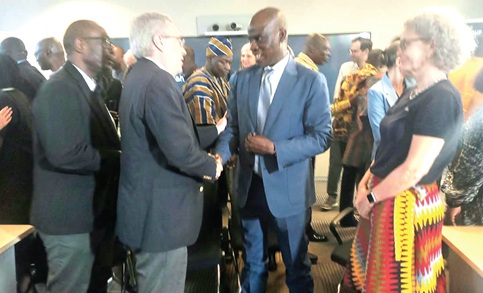
The nation has made real progress in expanding access and strengthening the systems behind teaching and learning in the country, the World Bank Director for Ghana, Liberia and Sierra Leone, Dr Rob Taliercio, has said.
He explained that gross enrolment at the kindergarten and primary levels had increased significantly from 60 per cent and 83 per cent respectively in 2000 to over 100 per cent in 2026.
According to the World Bank, a child born in Ghana today "can expect to complete 10.7 years of schooling and that is really a notable progress".
The World Bank Country Director, however, said access to learning was not enough and that too many children completed early grade without mastering the skills expected for their age.
Gaps
"These gaps compound over time, leaving ill-equipped for secondary education and workforce skills.
"In 2025, just 49 per cent of candidates passed their West African Senior School Certificate Examination (WASSCE) in Mathematics and in 2019, IFC study found that just 22 per cent of adolescent boys and eight per cent of girls have relevant ICT skills, while more than 60 per cent of jobs needed at least basic digital fluency," Dr Taliercio said.
The World Bank Country Director said this in Accra yesterday at the Ghana and Regional Foundational Learning Evidence and Implementation Support Day.
The event is being hosted by the Ministry of Education in collaboration with the World Bank, Foreign Commonwealth and Development Office (FCDO) of the United Kingdom (UK) and UNICEF.
The one-day event was attended by government officials, development partners, researchers, implementing agencies and education practitioners to review emerging evidence, share regional lessons and identify priority actions to strengthen foundational learning in Ghana and across the region.
Youth
Dr Talercio said Ghana's youth unemployment rate was 36.6 per cent, more than double the national rate and that was an important agenda to tackle.
Through Ghana Accountability for Learning Outcomes Project (GALOP) and its additional financing, Ghana was scaling up a comprehensive package of interventions to address weak foundational reading and Maths skills, the root cause of the problem.
"These reforms are ambitious and are being implemented across the country. Their success would depend not only on sound design but on quality implementation and the systematic use of evidence," Dr Talercio pointed out.
Decades
The Minister of Education, Haruna Iddrisu, said over the past decades the country had made significant strides which had resulted in some substantial progress in expanding access to education.
He said primary enrolment was close to the universal, and that participation had increased across the education system, adding that completion rates had also improved.
"These are important achievements, yet the evidence also presents us with a more fundamental challenge," he said.
Access
Mr Iddrisu asked whether access to school automatically translated into learning and that there were learners in school who were simply not learning.
"We need to prioritise basic foundational learning, realign and direct investment into foundational learning, recognising that foundational learning unmistakably is a gateway to the success of any educational system.
The Education Minister said the priority of foundational learning should be on literacy and numeracy.
“We should not just be measuring education outcome by how much infrastructure we have provided, how much quality assurance we have provided,” he said.
Mr Iddrisu stressed that the country must now be asking the questions of whether the children were learning, and “are they acquiring their grade level competences expected of them at that particular level?”
Unemployment
The education minister stressed that addressing unemployment and underemployment of young people was simply not possible without education.
So to address that, he said, "we need to invest in education, and more particularly, in skills training and skills development for our young people".
Mr Iddrisu commended the World Bank and its support for the GALOP.
GALOP, he said, used evidence to identify approximately 10,579 low-performing basic schools and directed additional resources and technical support towards them.
"Equal financing does not necessarily produce equitable outcomes, and this area must also attract research investigation. Schools operate under different circumstances.
A school serving a disadvantaged rural community may face shortage of trained teachers, inadequate teaching and learning materials, and significant socioeconomic barriers,” Mr Iddrisu pointed out.
“Providing the same level of support to schools facing very different circumstances will not necessarily produce equitable learning outcomes,” he said.
The Development Director of the British High Commission, Terri Sarch, recognised the strong partnership between the government and development partners, researchers and implementing organisations.
