
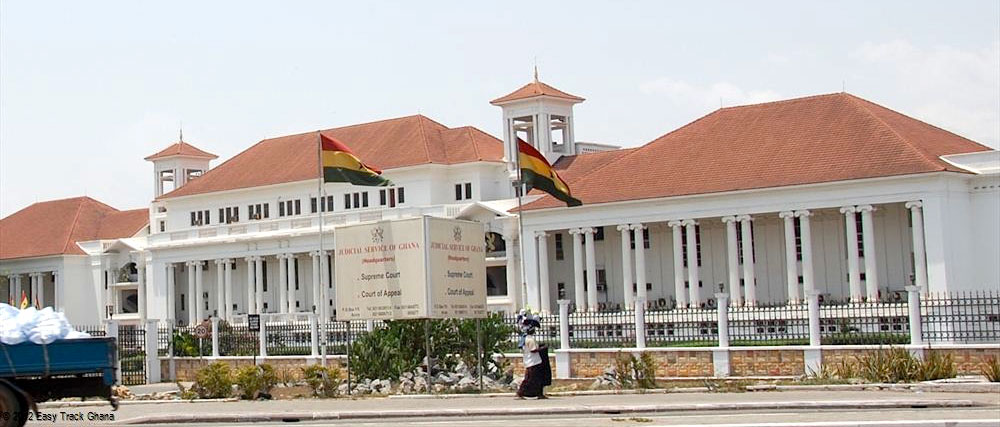
The Supreme Court will on Friday (August 21, 2026) determine whether to restrain the High Court from conducting criminal trials during the ongoing legal vacation until the determination of a substantive suit challenging the constitutionality of administrative warrants issued by the Chief Justice.
Justice Gabriel Pwamang who heard the motion as a single judge gave the dates after hearing arguments for and against the grant of the interlocutory injunction
The suit
The application is tied to a substantive suit filed by the Member of Parliament for Ofoase-Ayirebi, Mr Kojo Oppong Nkrumah, against the Chief Justice and the Attorney-General.
The MP is asking the apex court to determine whether administrative warrants issued by the Chief Justice, directing selected High Court judges to sit and conduct criminal trials during the legal vacation, are constitutional.
Counsel for the plaintiff-applicant, Mr Frank Davies, told the court that the warrants allowed judges to conduct cases as though sitting in an ordinary term, rather than under the limited scope of vacation sittings, and that this contravened Article 296 of the Constitution on the exercise of discretion.
Preliminary legal objection
Before arguments on the injunction began, Mr Davies raised an objection to the Deputy Attorney-General, Dr Justice Srem-Sai, representing both the Chief Justice and the Attorney-General in the matter.
He argued that because the Chief Justice was being sued over an administrative decision, established authority required that he be represented by counsel other than the Attorney-General.
He cited a plethora of Supreme Court decisions to support his argument.
The Deputy Attorney-General, Dr Srem-Sai, opposed the objection, arguing that a separate legal representative for a constitutional office holder was only required where there was a conflict between that office and the position of the Attorney-General, relying on the Domelevo case.
He maintained that no such conflict had been demonstrated and that the Chief Justice, as administrative head of the Judiciary, was properly represented by the Attorney-General.
Ruling on the objection, Justice Pwamang held that the Chief Justice had been served with the processes and had indicated his representation.
He added that the legal representation permitted by the Attorney-General did not diminish the Attorney-General's own standing as a defendant in the suit.
Full reasons for this ruling is expected to be delivered tomorrow.
Substantive motion
Moving the substantive motion, Mr Davies relied on the affidavit in support filed on August 14, 2026, and a supplementary affidavit filed on the morning of the hearing.
He submitted that it had been the practice of the courts to hear only urgent and non-contentious applications during legal vacation, with trials proceeding only where lawyers and judges agreed on dates and a vacation warrant was taken from the Chief Justice.
He contrasted this with the case of Republic v Wontumi, in which a bail pending appeal application was adjourned to October 15, 2026, into the next legal term, when the judge was indisposed.
Mr Davies argued that continuing trials under the warrant, in some instances with judges indicating that accused persons would be made to conduct their own defence in the absence of counsel, infringed on the right to legal representation.
He said the harm to accused persons could not be remedied by monetary compensation, and that the balance of convenience favoured suspending the trials until the constitutional question was resolved.
Response
Opposing the application, Dr Srem-Sai submitted that the court, in considering an interlocutory injunction, had to weigh whether a serious question existed for trial, whether there was a risk of irreparable damage, and where the balance of convenience lay.
He argued the applicant's case rested on a misunderstanding of the distinction between the Chief Justice's administrative power to issue warrants, which the applicant himself acknowledged existed, and the judicial discretion of individual judges in managing their cases.
“Any grievance about how a trial judge conducted proceedings under a warrant ought to be pursued by way of certiorari against that judge, not an original action against the Chief Justice,” he said.
He further contended that no established tradition barred trials during legal vacation, and that lawyers at the Bar could not dictate to a judge what matters would be heard.
On irreparable harm, he submitted the applicant, who was not a party to the underlying criminal trials, had not shown any exceptional circumstances to displace the presumption that a public officer's exercise of discretion was regular.
