
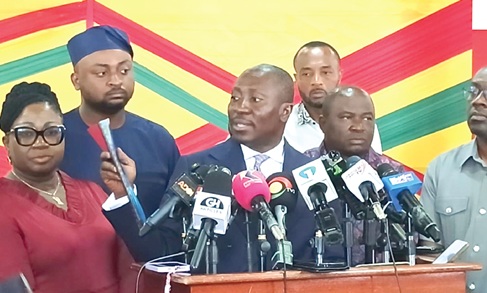
The Minority Caucus in Parliament has called on the Ghana Gold Board (GoldBod) to account to Ghanaians for how it incurred $1.7 billion, or the equivalent of GH¢22 billion, in losses in its gold trading operations in 2025.
The Caucus said per the International Monetary Fund (IMF)’s report on Ghana’s Domestic Gold Purchase Programme (DGPP), the Bank of Ghana (BoG) accumulated gold and intermediated foreign exchange to the private sector, which led to the state taking a $1.7 billion hit in underrecoveries.
Addressing a press conference in Parliament House in Accra yesterday, the Minority Leader, Alexander Afenyo-Markin, said the loss represented approximately 1.5 per cent of Ghana's gross domestic product (GDP).
In the view of the Caucus, such losses amounted to causing financial loss to the state, and GoldBod was responsible for causing such a loss.
“The losses are contained in the latest IMF report, which is the Fund’s sixth and final review of Ghana's Extended Credit Facility programme completed on July 10 this year concerning the financial consequences of the National Democratic Congress (NDC) government's domestic gold purchase programme,” it said.
Accountability awaits
Mr Afenyo-Markin said the government had already accepted the IMF report findings and was acting on the concerns raised by the IMF.
He warned that if the GoldBod failed to heed the advice, the day of reckoning would come, and they should remember that post-regime “accountability awaits them”.
Blatant lies
Responding to the Minority’s allegation, the Chief Executive Officer of the GoldBod, Sammy Gyamfi, described the allegations by the Minority Leader as “blatant lies being persistently peddled that the GoldBod has made losses”.
“It is only a figment of his hallucinatory imagination.
What a joke of a Minority Leader he is,” he said.
He said per the audited Annual Report and Financial Statements of the Ghana Gold Board for the year ended December 31, 2025, there was an operational surplus/profit of GH¢907 million and overall surplus/profit of GH¢5.4 billion.
“For the avoidance of doubt, this audit report was prepared and published by the Auditor-General of the Republic of Ghana. Facts are sacrosanct,” he said.
Mr Gyamfi gave an indication that he would fully respond to the claims at the Government Accountability Series today.
Scrutiny required
However, speaking at the press conference, Mr Afenyo-Markin stated that GoldBod was entitled to make the accounting point that it was purchasing gold on behalf of BoG, but the agency did not extinguish its operational responsibility.
He said an agent entrusted with billions of cedis of public resources remained responsible for the quality of its execution.
The Minority Leader explained that the GoldBod’s own description of its mandate confirmed that it occupied a central position in Ghana's gold trading structure with exclusive authority over buying, selling, weighing, grading, assaying, valuing and exporting gold.
Therefore, Mr Afenyo-Markin said, GoldBod must tell Ghanaians what prices were paid for gold, how those prices were determined, and what premiums, if any, were paid to secure the supply.
He said the board must tell Ghanaians how international off-takers were selected, at what discounts dory gold was sold, how much was earned by GoldBod in service and assay charges from transactions financed by BoG, what commercial risk the GoldBod itself bore as well as what transactional risk was passed automatically to BoG.
“What internal risk controls existed to protect the financier—the Bank of Ghana—, what corrective measures were taken as losses accumulated, and most importantly, if GoldBod controlled a critical part of the trading process but BoG absorbed the losses, where precisely did commercial accountability reside,” he said.
“A business model where one entity earns fees, and another absorbs losses requires scrutiny.
“If an institution earns transaction-based income for purchasing, assaying and aggregating gold while the financial financier bears the underlying trading losses, GoldBod must know that the increasing transaction volumes may increase the agent revenue even where the overall programme destroys value for the principal,” he stated.
No surplus
Mr Afenyo-Markin said the Minority conceded that it was an Auditor-General who had conducted an audit but claimed that the A-G was not given access to the full picture.
“If the Auditor-General knows that indeed the cost of GoldBod’s transactions was borne by the Bank of Ghana, the Auditor-General would not declare surplus in each accounting reporting,” the Minority Leader stated.
“GoldBod took Bank of Ghana's money to assay gold and collect fees, and it cannot claim the credit that comes with the revenue while pushing every loss into the central bank's balance sheet.
“This is precisely why Bank of Ghana has decided to stop gold purchasing operation going forward,” he said.
BoG technically bankrupt
Mr Afenyo-Markin pointed out that the losses generated by GoldBod’s own purchasing, pricing and sales decisions could no longer sit in the central bank's books while GoldBod enjoyed the credit.
He argued that what Ghanaians were witnessing was a disingenuous accounting arrangement “clean on the surface but dirty in substance”.
He, therefore, challenged the GoldBod to come clear on who were the off takers, why were sales discounted and why was the mandate to trade gold on the country's behalf producing losses the country was never told about.
On the impact such bleeding has had on the central bank, the Minority Leader said that, by the IMF’s own numbers, the BoG's equity stood at negative GH¢93.8 billion at the end of last year, representing negative 6.7 per cent of GDP.
“Our central bank is technically bankrupt; therefore, a single biggest driver of that collapse in 2025 was gold operations by GoldBod,” Mr Afenyo-Markin said.
“These losses are not bad luck, as you do not trade in gold and make losses, and they expose a crass incompetence of GoldBod’s management and misaligned policy of the government,” he said.
