
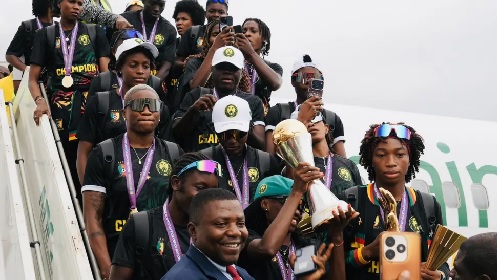
Cameroon became only the fourth nation to win the Women’s Africa Cup of Nations (WAFCON), joining Nigeria, Equatorial Guinea and South Africa, after a convincing 3-0 victory over Malawi in Sunday’s final.
Despite being postponed just 12 days before the tournament was due to begin in March, the 2026 edition in Morocco can largely be considered a success.
Three weeks of competition in Rabat and Casablanca offered plenty of lessons about the direction of women’s football in Africa.
1. Expansion worked
The decision by the Confederation of African Football (CAF) to expand WAFCON from 12 to 16 teams proved worthwhile, even though the announcement came midway through a qualifying campaign originally designed to produce 12 finalists.
Cameroon were the biggest beneficiaries. After being eliminated by Algeria in qualifying, the Indomitable Lionesses secured their place through their world ranking and went on to win the tournament.
Ivory Coast, who also missed the previous WAFCON, benefited in the same way. They topped their group before losing to Algeria in the quarter-finals.
All four semi-finalists also secured places at the 2027 FIFA Women’s World Cup. Malawi and Algeria will make their World Cup debuts alongside Cameroon and hosts Morocco.
More high-level matches are vital to the growth of women’s football across the continent, and the 16-team format appears to be a positive step.
2. The gap is closing
Unlike the 2024 tournament, which produced relatively few major upsets, WAFCON 2026 showed that the competitive gap between Africa’s leading teams and emerging nations is narrowing.
Tanzania shocked South Africa despite being 65 places below them in the world rankings, while the defending champions needed a 99th-minute equaliser to draw with Ivory Coast.
The biggest surprise came from debutants Malawi. The Scorchers stunned 10-time champions Nigeria 3-2 in their opening match before defeating Ghana and Algeria to reach the final.
The Chawinga sisters were central to Malawi’s attacking success, but the team’s overall performance should see them rise significantly from their previous world ranking of 153rd.
Zambia were unlucky to miss out on the knockout stage despite collecting six points, while Mali were eliminated on goal difference after finishing level with Ghana on four points.
There were 90 goals in 32 matches, an average of 2.81 per game, up from 2.54 in 2024. That suggests the tournament was not only more competitive but also more entertaining.
3. Female coaches are making their mark
Cameroon’s Valentine Nguele became only the fifth female coach to guide a team to the WAFCON title.
She joins Clementine Toure, Eucharia Uche, Florence Omagbemi and Desiree Ellis, who previously won the competition with Equatorial Guinea, Nigeria and South Africa respectively.
Nguele’s achievement is particularly impressive because she took charge only in June. In a short period, she helped transform a team that was initially without a settled structure into continental champions.
The victory underlines the importance of creating more opportunities for African women to occupy coaching and technical leadership roles.
4. Nigeria’s dominance can no longer be taken for granted
Nigeria arrived in Morocco seeking a record-extending 11th WAFCON title but endured their worst-ever campaign.
The Super Falcons were punished for failing to win their group when they were eliminated by Cameroon in the quarter-finals. Their problems deepened when South Africa defeated them 2-1 in the World Cup play-off, leaving Nigeria out of the Women's World Cup for the first time.
For years, Nigeria’s depth of talent—much of it developed or based abroad—has helped compensate for weaknesses in the domestic football structure.
That advantage is becoming less decisive. Morocco is investing heavily in the women’s game, Cameroon have shown their strength, while Algeria, Ghana and Malawi are all making significant progress.
Former Nigeria striker Desire Oparanozie has called for a “fresh start” and a comprehensive review of the national team.
The Nigerian Football Federation’s fact-finding committee now has the opportunity to address deeper structural issues rather than simply treating the tournament as a one-off failure.
5. There is still plenty of work to do
The tournament also exposed several weaknesses.
Attendances for matches not involving hosts Morocco remained disappointing, continuing a pattern seen at the 2022 and 2024 editions. Travel costs, visa requirements and the late rearrangement of the tournament likely contributed to the poor crowds.
VAR also needs improvement. One review during Cameroon’s group-stage match against Mali reportedly lasted almost four minutes, highlighting the need for quicker decision-making.
There were also questions about penalty decisions awarded to Morocco late in their semi-final against Cameroon and their third-place play-off against Algeria. Yet the hosts’ biggest problem from the spot was their own finishing: Morocco failed to convert nine of their 13 penalties during the tournament.
What next?
Morocco have now hosted the last three WAFCON tournaments, but it remains unclear whether they will host the 2028 edition.
CAF has yet to announce when and where that tournament will take place, and scheduling will be complicated by the Los Angeles Olympics, which run from 14 to 31 July 2028.
The 2024 WAFCON was itself delayed because of a clash with the Paris Olympics. African women’s football needs a stable and predictable place in the international calendar.
For now, attention turns to qualification for the 2028 Olympics, which resumes in October, while South Africa and Ghana will compete in an inter-confederation pathway for next year’s Women’s World Cup.
WAFCON 2026 showed that African women’s football is becoming more competitive, more unpredictable and increasingly difficult to dominate.
The challenge now is to build on that progress with better structures, stronger domestic leagues, fuller stadiums and greater investment across the continent.
