
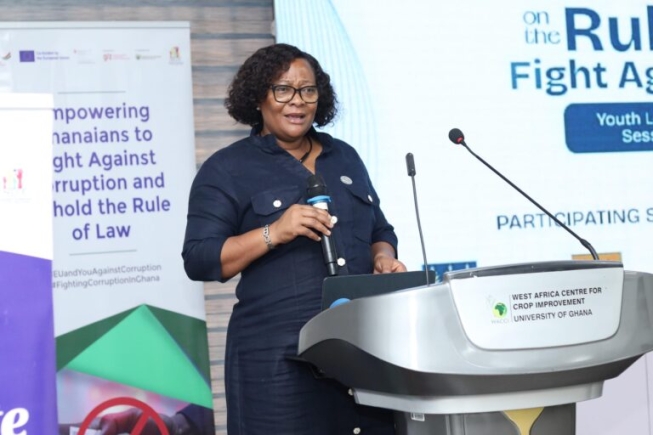
The fight against corruption in Ghana has stagnated, with no evidence of change, the Executive Director of Transparency International (TI-Ghana), Mary Addah, has stated.
She said the situation remained dangerous for the sustainable development of the country.
Mrs Addah explained that the country's performance in the Corruption Perceptions Index (CPI) published by Transparency International peaked at 48 per cent in 2014, giving an indication that the fight against the menace has not been the best.
After the 2014 CPI performance, data showed the country’s score dropped steadily to a low of 40 points in 2017.
The score, however, recovered slightly to 43 points, where it largely plateaued between 2020 and 2023, dipped slightly to 42 in 2024, and returned to 43 in the 2025 assessment.
Mrs Addah said the CPI performance was dangerous for national development, adding that urgent and robust measures were required to improve the situation.
Particularly, she said, it was more worrying that administrative corruption was becoming normalised in the country.
"We are fast to pay to facilitate processes. Some students do not attend lectures, but find their way out to get good grades, and this form of corruption cuts across all areas," she said.
Mrs Addah was speaking at a youth leaders empowerment dialogue and civic engagement on the rule of law and the fight against corruption at the University of Ghana last Friday.
The programme was a partnership with the National Commission for Civic Education (NCCE), the European Union (EU), the German International Development Cooperation (GIZ), and the Ministry of Finance.
It brought together students from public universities such as the University of Ghana, University of Media, Arts and Communication (UniMAC), University of Professional Studies, Ghana (UPSA), and Accra Technical University (ATU).
Effective laws
Mrs Adda said fighting corruption would require that the rule of law was enforced in a manner that promoted justice and transparency.
"If the law says that we must be transparent, that should be the case. Governments must be open in the way things are done; individuals who occupy public office must come clear and be transparent in their dealings," she said.
She said it was worrying that although the 1992 Constitution had made adequate provisions for the rule of law, probity, accountability and declaration of assets, corruption still thrived in the country.
Mrs Addah stressed that there must be effective checks and balances among the three arms of government, namely the Executive, Legislature and Judiciary, to ensure the proper functioning of the country.
For his part, the Deputy Chairman in charge of Operations at the NCCE, Samuel Asare Akuamoah, underscored the need for efforts to incorporate patriotism, honesty, and accountability into the training of young people to help in the fight against corruption in the long run.
He said corruption had economic and social impacts on sustainable development, and must be tackled head-on.
"There is evidence that corruption costs the country $3 billion every year, and you can imagine what the country could have done with this money if we are able to curb this menace," he said.
