
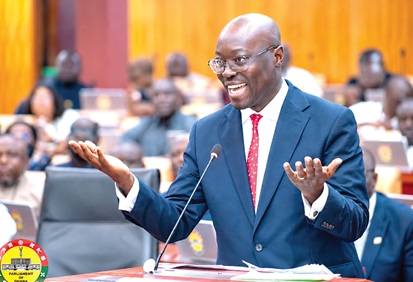
The government has paid GH¢10.82 billion to bondholders under the Domestic Debt Exchange Programme (DDEP).
This brings the total amount paid to bondholders since 2025 to GH¢41.36 billion.
The Ministry of Finance told the Daily Graphic that the third DDEP coupon payment was made fully in cash at the close of business yesterday.
The source said the payment was also made in full and on schedule, demonstrating the government’s fiscal discipline and firm commitment to meeting all its debt obligations.
“We believe this will strengthen investor confidence, reduce sovereign default risk and reinforce Ghana’s financial credibility,” the Minister of Finance, Dr Cassiel Ato Forson, said.
On behalf of the government, he assured bondholders, investors and the public that “all future DDEP obligations will be paid in full and on schedule.”
Impact on budget
Throwing light on the impact the payment has on government business, the Finance Minister explained that since the DDEP obligation was catered for in the current year’s fiscal framework, settlement of the obligation would not impact other critical government expenditures such as wages, capital projects and social programmes.
“Making this coupon payment reinforces market confidence by demonstrating strong fiscal discipline and government’s unwavering commitment to honouring all its upcoming debt obligation, by lowering perceived risk of sovereign default”.
Dr Forson added that modern debt management tools and systems were being deployed so that debt management would become not just about repayment, but also about protecting the public purse and strengthening the country’s financial credibility.
Since 2025, the government has demonstrated its continued commitment to the terms in the restructuring memorandum by honouring all debt obligations in full and on schedule.
The Finance Minister added that the operationalisation of the Sinking Fund Accounts, dedicated cedi and dollar accounts, confirmed the country’s renewed credibility and long-term fiscal prudence.
“These accounts are now fully operational with contributions from approved allocations specifically earmarked for meeting future debt repayments,” he added.
“Furthermore, the existing Debt Service Reserve Cedi and Dollar Accounts (DSRCA and DSRDA) have been designated as buffer accounts to support cash management objectives and Liability Management Operations,” Dr Forson said.
DDEP payments
Aside from honouring the Eurobond (external) obligations, the government also paid GH¢9.69 billion to cedi-denominated domestic bondholders on August 19, 2025, bringing the total payout under the programme last year alone to GH¢19.4 billion.
The payment marked the sixth coupon settlement under the programme and represented the second full cash payment, with no Payment-In-Kind component.
To further back its promise of repayments on schedule, the government has rolled out two new safety nets — a Cedi Sinking Fund and a US Dollar Sinking Fund — to serve as financial cushions for repaying bonds maturing in 2026, 2027 and 2028.
As of mid-2025, the DDEP had reportedly cost the nation approximately GH¢61.7 billion, significantly impacting the financial sector, banks and individual investors.
Background
On December 4, 2022, the New Patriotic Party (NPP) government launched the DDEP in a bid to restructure domestic bonds of about GH¢137 billion and reduce the country’s debt expressed in terms of general productivity – Gross Domestic Product (GDP) – from the region of 85 per cent to sustainable levels.
The government later launched the Eurobond Debt Exchange Programme in 2023.
The extensive restructuring of domestic debt and Eurobonds was a key component of and a precondition for admission into the Extended Credit Facility (ECF) programme of the International Monetary Fund (IMF) for a $3 billion economic bailout to address unsustainable debt levels, which were hitting more than 85 per cent of GDP.
The DDEP became necessary as debt servicing was, at the time, absorbing more than half of total government revenues and almost 70 per cent of tax revenues.
The total public debt stock, including that of State-Owned Enterprises and all, had also at the time exceeded 100 per cent of GDP.
The DDEP was, therefore, announced to restore the country’s capacity to service debt.
The initial terms of the programme were, however, met with stiff opposition, forcing the government to withdraw it and replace it with 12 new ones at a reduced coupon rate of nine per cent and a haircut of about 30 per cent.
The government revised the terms of DDEP for individual bondholders who wished to participate in the programme.
Per the new terms, individual bondholders who were below the age of 59 years were offered instruments with a maximum maturity of five years, instead of 15 years, and a 10 per cent coupon rate.
All retirees, including those who retired in 2023, were offered instruments with a maximum maturity of five years, instead of 15 years, and a 15 per cent coupon rate.
The Ministry of Finance also signed a Memorandum of Understanding with Organised Labour on December 22,2022 and proffered a separate arrangement with Organised Labour and Pension Fund Trustees in accordance with the debt management programme.
In the end, the DDEP was described as a success, as the government swapped old bonds valued at GH¢82 billion for 16 new ones at reduced coupon rates and longer tenors after further engagements with bondholders.
The second phase of the debt treatment exercise was Eurobonds – dollar-denominated bonds issued in the international capital market – as well as bilateral (countries that lent to the country) and some multilateral debts.
