
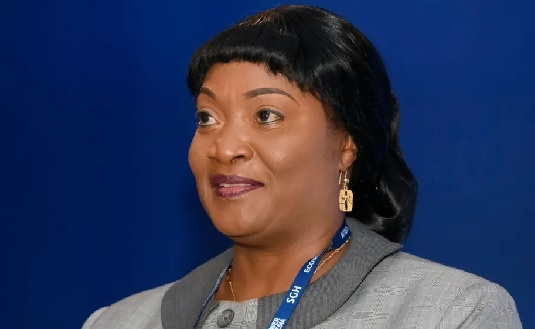
Liberia has charged former Vice-President Jewel Howard-Taylor with drug trafficking, money laundering and a range of other offences as part of an investigation into an alleged transnational narcotics network.
She was detained on Wednesday before she could board a flight at Roberts International Airport in Monrovia, the country's Justice Ministry confirmed.
Police chief Gregory Coleman has linked her to the seizure last month of cocaine valued at $317m (£233m).
The 63-year-old politician has not yet made any public comment on the charges. The BBC has contacted her lawyer for comment.
Howard-Taylor entered politics after her then-husband, former President Charles Taylor, left power. A former rebel leader, Charles Taylor was elected Liberia's president in 1997 and remained in office until 2003.
He was later arrested and convicted by a UN-backed court of aiding and abetting rebels in neighbouring Sierra Leone during the country's 1991-2002 civil war, in which about 50,000 people died.
Howard-Taylor faces charges including the unlicensed importation, sale and transportation of controlled drugs, illicit trafficking, criminal solicitation and criminal facilitation.
Police have also charged three foreign nationals — two Croatians and one Ukrainian — in absentia as part of the investigation. They are accused of being members of the same network as the former politician.
Liberian Justice Minister Oswald Tweh said the authorities would use domestic and international measures to locate and arrest them.
Liberia has stepped up its crackdown on cocaine trafficking following two major seizures in June and July.
Almost four tonnes of cocaine believed to have been bound for Europe were found during a raid in July.
The authorities described it as Liberia's biggest drug bust and said it had uncovered a sophisticated transnational trafficking network.
The investigation has since expanded to include senior figures within Liberia's security establishment.
The government says its investigation is aimed at identifying not only those directly involved in transporting drugs, but also financiers, organisers and people accused of helping to protect the operation.
"No office is too high, no political connection is too powerful, no nationality provides immunity, and no individual is beyond the reach of the law," it said in a statement.
West Africa has increasingly become a major transit route for cocaine trafficking from South America to Europe, with traffickers exploiting porous borders and weak enforcement in parts of the region.
