
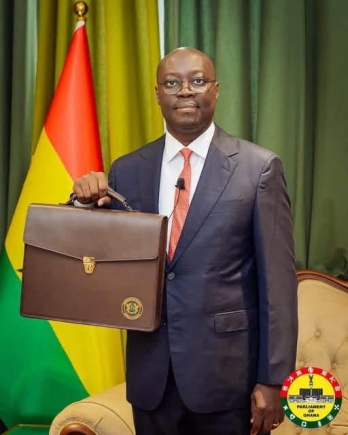
Civil society organisations (CSOs) have called on the government to make job creation, stronger revenue mobilisation and greater transparency central to the 2027 Budget Statement and Economic Policy.
They also want the government to strengthen the management of mineral revenues, close tax loopholes, tackle illicit financial flows and ensure that Ghana derives measurable benefits from tax exemptions granted to companies.
The demands were made at a CSO engagement on the 2027 Budget in Accra, where representatives of the Economic Governance Platform, the National Resource Governance Institute (NRGI), the Africa Centre for Energy Policy (ACEP) and the Tax Justice Coalition presented proposals for consideration by the Ministry of Finance.
The forum, organised by the Economic Governance Platform and Oxfam, was aimed at gathering inputs from civil society into the 2027 Budget and the medium-term framework.
The engagement comes as the government prepares the 2027 Budget, which Finance Minister Dr Cassiel Ato Forson is expected to present to Parliament in November.
The minister has previously indicated that the government’s proposed “New Economy” programme, aimed at moving the economy from stability to accelerated development and job creation, will be outlined in the 2027 Budget.
From stability to jobs
On the macroeconomic outlook, a representative of the Economic Governance Platform, Ebenezer Okley, said the government should leverage the gains made in macroeconomic stability to deliver concrete benefits to Ghanaians.
He said while the government had focused significantly on restoring macroeconomic stability over the past year and into 2026, the priority for the 2027 Budget should be to translate that stability into jobs, price stability and improved welfare.
He said the 2027 Budget should clearly demonstrate how macroeconomic stability would lead to increased employment and stronger economic fundamentals.
Mineral revenue
On the extractive sector, David Adjei of NRGI called for a comprehensive framework for managing mineral revenues.
He said mineral revenues were currently governed by different laws and proposed that royalties, taxes and other mineral-related revenues be brought under a single framework to make it easier to track how the proceeds were collected, allocated and spent.
Under the proposed framework, he said, mineral revenues could be channelled into the national budget, savings for future generations and sub-national governments.
Mr Adjei also called for greater clarity on the mandate and financing of the Minerals Income Investment Fund (MIIF), questioning whether its current allocation of two per cent of mineral royalties was sufficient to enable the fund to effectively manage mineral-related investments.
Mr Adjei further called for clearer boundaries around the expanding functions of the Ghana Gold Board (GoldBod) to prevent overlaps with institutions such as the Minerals Commission and other state agencies.
He also raised concerns about the limited disclosure surrounding the reported acquisition of the Ewoyaa lithium project, owned by Atlantic Lithium, by a Chinese company.
He called on the government to ensure transparency in such transactions by disclosing the beneficial ownership, transaction terms and valuation benchmarks associated with the transfer of critical mineral assets.

Small-scale mining
The NRGI representative also called for measures to increase the fiscal contribution of the artisanal and small-scale mining (ASM) sector.
He said despite the boom in gold exports and rising mineral royalties, the contribution of the ASM sector remained low.
He advocated the formalisation of ASM operations and the introduction of measures to ensure that operators contributed appropriately to government revenue.
Tax compliance, incentives
For the Tax Justice Coalition, its National Coordinator, Benedict Doh, called for stronger action against illicit financial flows and greater transparency in the granting of tax exemptions.
He said literature indicated that about 65 per cent of illicit financial flows were associated with commercial activities, making stronger transfer-pricing enforcement critical to protecting domestic revenue.
Mr Doh also proposed incentives to encourage voluntary tax compliance.
He suggested that taxpayers who insisted on receiving VAT invoices or receipts from businesses could be rewarded through tax reliefs, refunds or other incentives.
He said such a system could encourage consumers to demand VAT invoices and thereby help businesses to accurately account for their tax obligations.
Mr Doh said Ghana’s tax-to-GDP ratio, currently at about 13 per cent, remained below the government’s medium-term target of 18 per cent by the end of 2027.
