
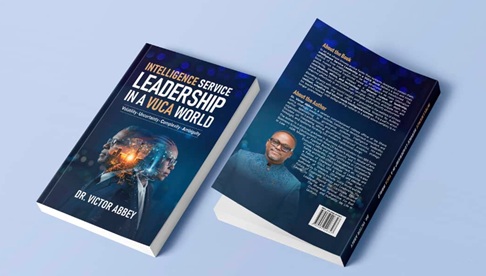
In an era marked by geopolitical uncertainty, cyber threats, artificial intelligence, violent extremism, and the rapid spread of disinformation, Dr Victor Abbey's latest publication, Intelligence Service Leadership in a VUCA World, has emerged as a significant contribution to contemporary strategic leadership and national security literature.
Officially reviewed by Major General Stephen Woseadzikpo K. Parbey, Chief of Defence Intelligence (CDI) - Ghana Armed Forces, the 266-page publication presents a compelling framework for leading intelligence institutions in today's Volatile, Uncertain, Complex and Ambiguous (VUCA) global environment.

Published by The Abbey Consult, the book is structured into three (3) parts and fifteen (15) chapters, combining strategic theory with practical guidance for intelligence professionals, military commanders, policymakers, academics and institutional leaders.
Unlike many traditional intelligence literature that focuses primarily on information gathering and covert operations, Dr Abbey broadens the discussion by presenting intelligence as a leadership function requiring strategic foresight, ethical governance, technological innovation and institutional resilience.
The reviewer describes the publication as “not merely an academic contribution but a strategic leadership manual for the modern intelligence enterprise”, noting that it successfully bridged classical intelligence doctrine with contemporary security realities.
The book begins with Part One by examining the changing nature of intelligence leadership in a world where traditional state-centric security threats have evolved into multidimensional challenges driven by cyber warfare, misinformation, hybrid conflict and emerging technologies.
A notable strength of the publication is its emphasis on constitutional accountability and ethical leadership. Dr Abbey argues that while intelligence organisations operate under secrecy, public trust and democratic oversight remain fundamental to their legitimacy and long-term effectiveness.
The book also dedicates significant attention to African intelligence systems, encouraging a shift away from colonial-era and regime-centred security approaches towards intelligence models that support human security, institutional resilience and sustainable national development.
In Part Two, the book explores institutional transformation, strategic foresight and the integration of emerging technologies such as artificial intelligence, quantum computing, blockchain and advanced analytics into intelligence operations. Importantly, Dr Abbey cautions against relying solely on technology, stressing that sound judgement, ethical leadership and strategic thinking remain indispensable in decision-making. He argues that intelligence organisations must move beyond being data-rich institutions to becoming insight-driven organisations capable of anticipating future threats.
The publication also provides practical recommendations on organisational reform, adaptive leadership, change management and building resilient intelligence institutions capable of responding effectively to evolving security challenges.
The final Part Three examines crisis leadership, command systems, international intelligence cooperation and the future of intelligence in the digital age.
The author, Dr Abbey, introduces the concept of intelligence leaders serving as “Chief Futurists”, emphasising that tomorrow's leaders must anticipate disruptions rather than merely react to them.
The reviewer particularly commends the book's balanced treatment of innovation and accountability, noting that while intelligence organisations must embrace technological transformation, they must equally safeguard ethical principles and public confidence.
According to Major General Parbey, Intelligence Service Leadership in a VUCA World is ultimately “a book about leadership under uncertainty, institutional adaptation under pressure, and strategic thinking in an age of disruption”.
He concludes that the publication arrives at a critical moment when intelligence and security institutions worldwide face unprecedented technological, ethical and geopolitical challenges.
Those that fail to adapt risk becoming obsolete, while those that modernise without ethical foundations risk losing public legitimacy.
Dr Victor Abbey is a veteran Ghana Army officer, strategic leadership scholar and Lead Consultant of The Abbey Consult.
He holds a Doctor of Business Administration degree and three master's degrees, and has authored several books on leadership, governance, strategy and national development.
With its blend of scholarship, practical insights and strategic vision, Intelligence Service Leadership in a VUCA World is expected to become an important reference for defence and intelligence professionals, security agencies, governance practitioners and students of strategic leadership.
As the reviewer aptly observes, the book serves both as a warning against institutional complacency and as a roadmap for building resilient, adaptive and future-ready intelligence services capable of meeting the complex demands of the twenty-first century.
AVAILABILITY
At the Command Mess and Arakan Officers’ Mess - Burma Camp, Air Force Officers’ Mess (near El-Wak Stadium), and the Main Office of The Abbey Consult at Earlbeam Plaza, No. 6 George Bush Highway, Dzorwulu - Accra. Readers can also call or send a request for an order via WhatsApp text to (+233) 0243361620 for copies.
