
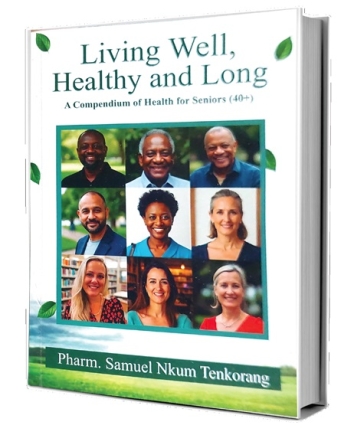
Ghana stands at a crossroads in its health journey.
With life expectancy at 66-69 years, below the global average of 73.8, the nation faces the dual challenge of infectious diseases and a rising tide of noncommunicable diseases (NCDs).
Women live longer (≈68.6 years) than men (≈63.7 years), yet both groups confront preventable risks that shorten healthy life years.
Against this backdrop, Pharm. Samuel Nkum Tenkorang’s Living Well, Healthy and Long: A Compendium of Health for Seniors (40+) arrives as a seminal text. It is not merely a book; it is a movement for dignity in ageing, a call to preventive health, and a manifesto for pharmacist-led advocacy in Ghana and West Africa.
The book empowers ageing populations with accessible, evidence-based guidance on wellness, dignity and longevity. It positions specialist pharmacists as pillars of ageing care, bridging knowledge gaps and advancing advocacy.
This mission is urgent. NCDs now account for 45 per cent of deaths nationally, with hypertension affecting 22.7 per cent of adults and diabetes rising steadily. Without preventive interventions, Ghana’s ageing population will face escalating costs and reduced productivity.
The book is structured around four pillars:
• Holistic health themes: Nutrition, exercise, medication adherence, mental resilience and lifestyle balance. In Ghana, 22.8 per cent of young adults consume processed foods high in salt, while 14.6 per cent of women fail to meet WHO activity recommendations.
• Pharmaceutical expertise: Practical insights tailored to seniors. Despite more than 4,000 pharmacists verified for recruitment, fewer than three per cent have been absorbed into public service, leaving many communities underserved.
• Inspirational narratives: Stories of resilience resonate in Ghana, where families often rely on informal care networks.
• Educational clarity: With 51 per cent of hypertensive individuals unaware of their condition, the book’s structured compendium format is vital for empowerment.
Contextual Relevance
Ghana’s epidemiological transition is stark. Facility surveys reveal 26.7 per cent prevalence of NCDs among adults, with hypertension at 22.7 per cent and obesity affecting nearly half of women (49.8 per cent ).
Nigeria reports hypertension at 28 per cent, while Senegal’s urban centres show rising diabetes rates.
Ghana’s situation mirrors a West African crisis where ageing populations grow, but preventive systems lag.
This book situates itself at the intersection of these realities, offering strategies that can decongest hospitals and empower communities.
The strength of the book includes:
• Accessibility: Written in clear language, reaching both professionals and lay readers.
• Evidence-based: Anchored in four years of desk and field research, complementing Ghana’s 2023 STEPS survey baseline.
• Cultural resonance: Integrates Ghanaian foods, traditions and practices, making recommendations relatable.
• Inspirational tone: Encourages lifestyle change in a country where four per cent of adults reported suicidal thoughts in the past year.
The launch event on 18 June 2026 at The Palms By Eagles, Airport City, Accra, is expected to achieve:
• Ceremonial visibility: Elevating ageing care as a national priority.
• Professional advocacy: Addressing Ghana’s pharmacists-to-patient workforce crisis.
• Network building: Linking dignitaries, institutions, and influencers around a shared vision.
• Public inspiration: Mobilising communities to embrace healthy ageing as a collective legacy.
Critical Reflections
The book’s preventive orientation is its greatest strength.
By emphasising lifestyle interventions, it challenges Ghana’s curative model, which often focuses on treatment after disease onset.
Dr Yvonne Esseku, Rector of the Ghana College of Pharmacists, has noted: “Pharmacists must lead in preventive health; not only dispensing medicines but guiding lifestyles.”
The Ghana Medical Association has warned that catastrophic health expenditures are rising despite NHIS coverage – underscoring the need for preventive care.
The book implicitly calls for reforms: expanding NHIS coverage to include screenings, integrating pharmacists into ageing policy frameworks and scaling workforce recruitment.
In conclusion, Living Well, Healthy and Long is more than a book launch; it is the birth of a movement.
It invites seniors to reclaim dignity, professionals to embrace advocacy and communities to see wellness as a shared responsibility.
As a Public Health expert, I commend Pharm. Samuel Nkum Tenkorang for this seminal contribution.
His work resonates not only in Ghana but across West Africa, where ageing populations demand urgent attention.
This compendium deserves to be read, discussed and implemented.
It is a torch of wisdom for homes, clinics and policy tables alike.
“Wellness is not a destination – it is a way of living.
This book lights the path.”
The writer is a WHO Expert in Public Health
