
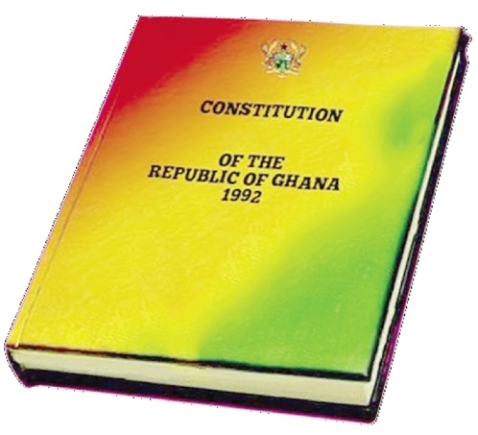
There comes a time in a nation’s life when the law must serve destiny, not delay it.
When a constitution, sacred as it may be, requires review not as an act of rebellion but as an act of responsibility.
Ghana stands at such a crossroad.
The question before us transcends party colours and political loyalties: If Ghana has found real momentum, should it interrupt it or complete it?
For the first time in decades, Ghana is witnessing the silhouette of sustained development.
Roads are being completed, hospitals expanded, economic calm returning and educational vision broadened.
These are not slogans; they are physical proofs.
Leadership has shifted from theory to evidence.
And the man driving this renewed confidence is John Dramani Mahama.
So, the conversation is no longer “Can he lead?” It is now “Should Ghana allow him to finish what he has begun?”
And deeper still, “Do Ghanaians have the courage to amend the constitution if progress itself requires continuity?”
Constitution
A constitution is meant to serve the people, not imprison their future. It is not a deity.
It is a national instrument designed to evolve with time.
The 1992 Constitution was written 33 years ago, in a Ghana vastly different from today.
Its framers intentionally built amendment paths because they understood no nation remains static.
So, reviewing term limits is not rebellion, it is responsible modernisation.
Democracy is not a museum. It must adapt when progress demands flexibility.
And sometimes, the highest law is not the text; it is the will of the people.
However, a leader does not deserve continuity simply by wanting it. It must be earned through performance.
And here Mahama stands out. Ghana tested him, rejected him and then invited him back.
He returned not bitter but refined. Not as a politician but as a finisher.
His second coming showed something rare in African politics: humility, maturity and strategic depth.
He did not abolish Free SHS; he strengthened it.
He expanded tertiary pathways.
His Big Push industrial agenda reintroduced long-term national planning.
Infrastructure became visible footprints across the land. And the national mood shifted away from cynicism toward cautious hope.
Mahama returned wiser, calmer and more determined to complete what he started.
If Ghana wants a finisher, then Ghana must rethink the rigidity of the two-term limit.
Restart cycle
Ghana’s greatest developmental tragedy is an endless reset every eight years. Each new administration discards projects, reverses policies, renames programmes and abandons unfinished work.
A president spends his first years learning the system, the middle years working and the last year campaigning.
Then a new leader arrives, dismantles the old agenda and prepares for another campaign.
Nothing completes. Nothing matures.
National development becomes circular; never linear.
Countries that industrialised, such as Singapore, Rwanda, South Korea and the UAE, did not change captains every eight years.
They kept visionaries long enough to finish the vision. Ghana must choose between progress and periodic amnesia.
The Legal Roadmap to a third term is clear if the nation chooses it. If the nation wants Mahama to continue beyond eight years, there is a constitutional pathway which is orderly, legal, democratic and transparent.
Legal sequence
The legal sequence: Step 1-National Public Debate. Universities, markets, unions, media.
The topic must become public thought, not secret talk.
Step 2-National Petition Movement -Millions of signatures; a people’s declaration, not a party slogan.
Step 3-Parliament receives and reviews the amendment proposal. Drafting of a continuity clause that allows performance-based return.
Step 4-Council of State Advisory Scrutiny.
For legitimacy, balance and national security hearings. Step 5-National Referendum.
The people vote on a single question: Should Ghana allow a performance-based return beyond two terms?
If the nation votes YES, then the constitution changes, not through power grabs but through democratic mandate. Mahama becomes eligible only through the people’s will.
What a continuity clause would look like. Not one-man rule. Not a lifetime presidency. Not limitless power.
A third term window must be earned through five conditions: 1.
Proven economic or developmental progress. 2. Stable governance with no constitutional breaches 3.
A parliamentary vote of approval on national interest grounds 4. A public referendum of national support and 5.
Eligibility is only once in a lifetime to prevent abuse.
This model is not a power extension. It is progress protection.
A leader continues only because the nation sees value, not because the leader desires it.
Why Mahama?
Why Mahama specifically fits this model is that Ghana has tested him twice.
The nation has seen: His infrastructure discipline. His educational expansion thinking.
His industrialisation framework. His political maturity after the loss.
His ability to return stronger, not bitter.
Few African leaders return from political loss more refined, more stabilised and more focused. Experience humbled him. Defeat sharpened him. His leadership today is steadier than before.
He is the kind of leader who benefits from continuity because he has already tasted power, lost it and returned with a finisher’s mindset.
The provocative question is why African development must start all over every eight years, while Asian development accelerates uninterrupted for decades.
Why must Ghana throw away progress for tradition instead of upgrading tradition for progress?
Why fear leadership continuity when the alternative is permanent repetition? If Mahama is performing, why lock progress behind a calendar? Laws should not limit destiny; they should support it.
A third-term President Mahama is not automatic. It is not guaranteed. It is not imposed. It is a democratic option waiting for democratic courage.
If Ghana believes leadership continuity is the key to completion, then citizens have the power -legal, constitutional, and sovereign- to reform term limits and retain the momentum that is finally rising.
The constitution is a national instrument.
And instruments are meant to be played, not worshipped silently.
If Ghana wants to finish what it has begun, then the road forward is one sentence long:
We must not stop progress because a calendar struck eight.
Great nations do not pause at the doorway of greatness.
They open it, walk through and complete the vision.
A third-term President Mahama is not a fantasy.
It is a choice. A legal, national, historical choice.
And the question is no longer whether he can lead.
It is whether Ghana is ready to evolve to win.
