
Yet again, citizens are at one another’s throats; this time about the judicial independence and political neutrality of the Judiciary or lack of it.
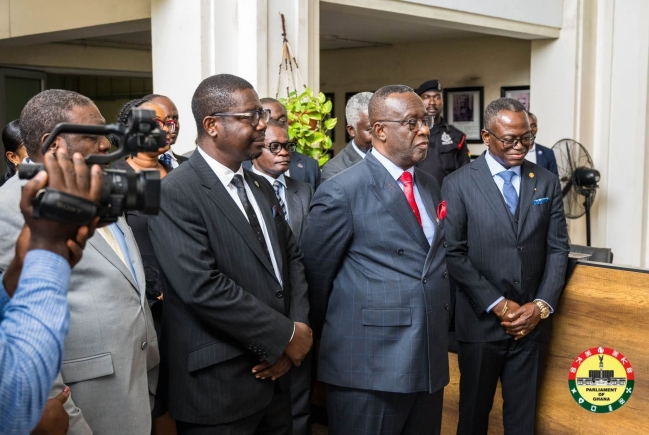
This follows comments attributed to the Lord Chief Justice, Baffoe-Bonnie, after a recent tour of some of the state organisations.
There is nothing inherently wrong with the Chief Justice of Ghana visiting a public institution, congratulating hardworking public servants and acknowledging improvements in the management of a state agency.
The Chief Justice remains a citizen.
Judges live in society and are not removed from the body politic.
They observe national developments and may have legitimate opinions about the progress or deterioration of the country.
It is, therefore, understandable that some have defended the Chief Justice’s comments at the Mineral Income Investment Fund (MIIF) and the Social Security and National Insurance Trust (SSNIT).
He saw what he regarded as positive developments and praised them.
What, they ask, is wrong with that?
On the face of it, very little.
But the office of Chief Justice is not an ordinary public office.
The Chief Justice heads one of the three arms of government.
Article 125 of the Constitution declares that the judiciary shall be independent and subject only to the Constitution.
Article 127 further provides that, in exercising judicial power, the judiciary shall not be subject to the control or direction of any person or authority.
Judicial independence
Judicial independence is not merely protection for individual judges.
It is a constitutional principle intended to ensure that the judiciary remains an impartial arbiter between citizens and the state, political parties and the executive and parliament.
For that reason, the words and conduct of the Chief Justice carry a significance that those of an ordinary citizen would not.
The key question is not simply whether he intended to make a partisan statement ‒ yours truly fully believes that was not the case ‒ but whether a reasonable member of the public could perceive his comments as placing the judiciary closer to one political side than another.
There is a legitimate argument on the Chief Justice’s side. He was visiting state institutions, not attending a political rally.
If the MIIF and SSNIT have generally improved their performance, why should this not be acknowledged?
A Judiciary completely detached from national affairs could become an institution divorced from the society it serves.
The Bangalore Principles of Judicial Conduct recognise that judges retain freedom of expression, belief, association and assembly, provided these freedoms are exercised consistently with the dignity of judicial office and the independence and impartiality of the judiciary.
Culture
Ghana also needs a culture that recognises good public administration, regardless of which party is in power.
A judge does not become incapable of recognising positive results merely because they are associated with a particular administration.
That would be taking neutrality too far.
The difficulty begins when praise for institutional performance becomes an assessment of political administrations.
The reported reference to “the past eight years” gives the comments a political complexion.
That phrase is difficult to hear as a purely administrative observation.
It immediately invites comparison between the former and current governments.
The New Patriotic Party (NPP) and some influential civil society organisations have condemned the comments of the Chief Justice and rightly so, when you look at it through the lens of judicial independence and political neutrality.
But, as a devout Catholic, I agree in toto with the stance of the Catholic Bishops’ Conference that the calls for the Chief Justice’s resignation are disproportionate.
As alluded to earlier, yours truly is convinced that the Chief Justice was not up to any political mischief. Indeed, the judicial service has released a statement clarifying that the Chief Justice’s remarks were made in good faith.
In the future, the lesson is that sitting C.J’s should avoid words that can reasonably be understood as endorsing one administration or condemning another.
A useful test is this: would the same words be acceptable if they had been spoken about an NPP government by a Chief Justice appointed under an NDC administration?
If not, they should not be spoken by the Chief Justice.
Ultimately, judicial independence rests not only on constitutional provisions but also on public confidence.
Chief Justice Baffoe-Bonnie should be allowed to be a citizen and recognise progress.
He must also remember that he is no longer merely an ordinary citizen but the Chief Justice of Ghana.
Sometimes, the most important exercise of judicial independence is not what a judge says but what he chooses not to say.
The writer is a lawyer.
E-mail:
