
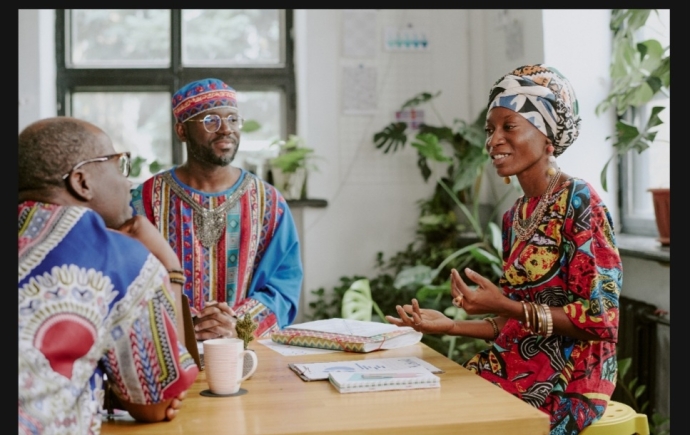
Africa, a socially and culturally perfectly imperfect continent. Imperfect by the world’s standards, yet perfect in its refusal to be anything other than itself.
A continent that appreciates its people; young, old, far and even near. A continent well embedded in traditions and cultures that make us whole. Because again, far or near, the African spirit stays, it dwells and it belongs.
Africans and people of African descent have, for several generations, stayed connected. But for the artificial separation caused by former slave owners, African descent would have been a term used in an entirely different context today.
Nonetheless, lines were drawn, demarcations were made and nations which once lived together were separated at conferences, during the slave trade and many more of the outrageous events surrounding us today in disguised forms; For those reasons, Africa and the diaspora today, seek repair, seek clarity, seek closure and most importantly, seek Reparations.
So today, in this article, is a spoken reality of truth, ideas and contexts given in the light of a 66-years old Ghanaian diasporan, who has lived more than half of his life in the diaspora, hoping to see a new Africa emerge from the west. Today, Mr. Edwin Janney, a writer and poet with some pieces on Pan-Africanism shares the realities in this conversation.
“You know, this is a big topic. Because when you say African, in terms of Kwame Nkrumah's definition years ago, you know, it's more about people moving to Africa to integrate with the African environment. That is, people of true intentions, that is whether by origin or affiliation or even curiosity.” said Mr. Janney as the conversations began. For him, the diaspora is no longer living without a vision but with well laid out plans that need unity for action.
The African diaspora is no longer simply searching for belonging. It is strategising with purpose. Across the world, people of African descent are increasingly reclaiming Pan-Africanism not as a historical memory, but as a living political and cultural responsibility. This is why today; the diaspora is on a mission. Particularly in the cultural aspect, this article seeks to awaken a sense of consciousness all around on how this mission can well be executed.
“I applaud the Pan-African Progressive Front (PPF) for reaching out to some of us. This is an important initiative because truly, our journey here has been long and trendy. But it is important for us to know issues and stay in touch, building the African network where we work together”. Mr. Edwin Janney added as he was engaged in the activities held by the front to ensure that Africans all around the world are unified and connected.
For generations, displacement has defined how the diaspora has been spoken about. According to Mr. Janney, it is often centered around the context of “a general move of people who want to come back, you know, to spend like their older days in Ghana after suffering and hustling all their lives in the diaspora.”
Yet what is becoming clear is that physical return to the continent is not the central objective for many, at least not until the early ages of retirement when Home is then the best place to be. The mission is not about relocation alone. It is about positioning. The diaspora understands that it already has a home; Africa, even when it lives and works across other geographies. Home is not reduced to borders; it is carried in political identity, cultural maintenance and socialization, historical consciousness and collective struggle.
“The purpose now, is more of how we can preserve certain traditions or major traditions, like; attitudes we portray when somebody dies, the funerals, the outdooring, you know, and things like that, we fight to preserve on a daily basis. As truly, Pan-Africanism and its concept of unity go together with the support we give to one another as commonly seen back home in Africa”.
In an era of renewed geopolitical competition over Africa’s land, minerals, data and political alignment, the diaspora occupies a strategic space. From media platforms to academic institutions, from cultural industries to policy advocacy circles, from social avenues to intra- personal education, Africans abroad are defending Africa’s narrative, challenging hostile propaganda and building transnational solidarity networks. They act as cultural and political bridges, connecting continental struggles to global public opinion and international institutions.
Meanwhile, this task to the diaspora is not an easy one as realities faced by the African people in the diaspora are such beyond their power. Edwin Janney mentioned that, to speak of the time and the availability even, to prioritize the discussions on Reparations and Pan-Africanism is a problem; as all they are able to do is work to make ends meet for themselves and their families. But he still believes there are solutions to the problem. “So, let’s look at the churches. If a pastor that has that strong political insight, and can infuse the Pan-African identity through their sermons and their coaching, it is one angle that can be utilised.”
What distinguishes this moment from earlier diaspora activism is intentionality. There is a clearer understanding that Pan-Africanism cannot be outsourced to states alone. It must be built socially, intellectually and economically by people themselves. The diaspora must act and demand — from its governments, from continental bodies, from local authorities — that Pan-African projects and projects on Reparations be resourced, implemented, and sustained on state level.
Through campaigns on Reparations, the right of return, digital sovereignty, historical education and economic justice, the diaspora can and will continue to help protect the ideological backbone of African authenticity and liberation.
The question, therefore, is no longer whether the diaspora belongs. It is how its organised power can be better aligned with continental movements. “We have unions. Unions that come together to organise events on Reparations and Pan-Africanism but the unions need help. To generate the interest, events have to be organized with the help of Ghana Embassy; to digress a little bit from their diplomatic role and organize, such as identifying individuals interested in that topic. And then organize major events together.”
Physical return remains meaningful for many, but presence without purpose changes nothing.
“I'm a poet. I've written a poetry book. And even on the topic of Pan-Africanism, I've written a lot of poems. You know, when I come to Ghana, I always do a poetry event, just not a national one. Perhaps next time I'll do a national one, and then I'll invite you. Maybe that way, I can also contribute to this struggle which we face today.”
“And to the older generation, I appeal to them that we must supplement the digitalization era of our young folks with real issues. This way, we the older generation can be of service to the younger ones even as we age away.” Mr. Edwin Janney ended.
The diaspora’s mission today is to strengthen Africa’s political capacity wherever Africans stand. The diaspora is not homeless. It is deployed.
