
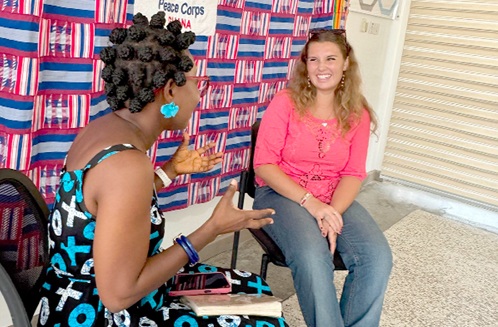
On Thursday, March 26, the United States (US) Embassy in Ghana commemorated the 65th anniversary of the US Peace Corps Volunteer Programme in Ghana by swearing in its largest cohort of 30 new Peace Corps volunteers.
The swearing-in marked the official start of the volunteer service for the new cohort, who would serve in eight regions of the country, namely Ashanti, Bono, Bono East, Eastern, Greater Accra, Northern, Oti and Volta, working alongside community members, local leaders and government partners to foster sustainable development and deepen people-to-people ties.
Peace Corps in Ghana traces its roots and mission to 1961, when former US President John F. Kennedy sent the very first 52 Peace Corps Volunteers to serve their country in the cause of peace by living and working in Ghana.
Those volunteers were received warmly by Ghana’s first President, Dr Kwame Nkrumah, on August 30, 1961. Over the past 65 years, Ghana has hosted nearly 5,000 Peace Corps Volunteers who have contributed to capacity-building initiatives, supported underserved areas, and fostered deep cultural exchange.
Peace Corps programme areas remained focused on agriculture, health and education.
Present at last Thursday’s swearing-in were serving Peace Corps Volunteers and past ones.
Rian Silcox, a graduate of the University of California, was one of those serving Peace Corps Volunteers who attended the ceremony.
She shared her experience as a health volunteer navigating packed clinic days, language barriers and cultural nuances with growing confidence and even a smile at the Gbrumani Community-based Health Planning and Services (CHPS) Compound in the Tolon District of the Northern Region with the Daily Graphic.
Clinic
The clinic, according to Ms Silcox, had an overwhelming number of patient attendance because it catered for the health needs of four other smaller communities.
Working at the maternal health and child welfare clinic, she said they attended to about 50 pregnant women each week, with her daily schedule being to attend to the pregnant women that came for antenatal clinics and babies that were brought in for child welfare clinics.
For the pregnant women, Ms Silcox checks the position of their foetuses, ensuring that they are not breached, and also their heartbeats. She also checks their blood pressure and gives them folic acid.
For babies brought to child welfare clinics, she is one of the nurses working on them to ensure they take all their vaccinations and are not malnourished.
Considering the fact that the community has quite a number of malnourished children, every single baby brought to the CHPS Compound was weighed, their length taken to make sure they are along the correct growth chart, and where they are falling below, interventions are introduced.
“We do a lot of malnutrition education, we give lots of supplements and make sure the babies get all the nourishment they require,” she said.
Ms Silcox said what she admired most about the local health system was the personal relationship it had with the community, explaining that at her facility, for instance, together with all the nursing staff, they do home visits to check up on mothers who had just delivered, make sure the babies were healthy, and where they noticed the baby had not been brought to child welfare clinic for sometime, they followed up to check whether all was okay with the baby.
“The nursing staff have a personal relationship with community members, which is so beautiful, and something that you do not see in the US,” she said.
Ms Silcox extends her volunteer work to the only junior high school in the community, where she educates the pupils on various issues, including environment, healthy bodies and mental health.
Today, she has established a school health club where she educates the pupils on reproductive health issues.
Culture
For her, however, the most interesting part of the volunteer work has to do with her ability to adapt to Ghana’s culture — the dressing, language, food and way of doing things. Ghanaian cultural lessons and language were a greater part of her three-month training prior to starting her volunteer work.
Thanks to that training, Ms Silcox said, she now speaks fluent Dagbani, which has enabled her to communicate effectively in Dagbani with her patients. Other
Ghanaian cultures that were alien to her but had now become part of her everyday life in order to integrate well with the community included bowing to people when she greeted, and desisting from using the left hand to greet people.
“In the US, eating with the left hand is something everybody does. We use our left hand for greeting, for passing things on to people and for anything, but here it means differently. Since I came here, I don’t remember the last time I used my left hand,” she said enthusiastically.
Today, she revealed, these cultural issues had become so much a part of her that when new volunteers tried to hand things over to her with their left hand, she declined to take them until they became conscious and changed to use the right hand to do so.
She said she had now become accustomed to the local dressing culture, too.
She said that because of the peculiar culture of the people in her community regarding dressing, she hardly put on jeans trousers in that environment. Rather, she wore long dresses mostly made from local fabrics.
Regarding local foods, Ms Silcox said she liked fufu and tuozafi, commonly called T-Z.
For Ms Silcox, the greatest impact the volunteer programme has had on her is the personal relationship the people have with her, such that even when they don’t see her for a day or hear from her, she receives several telephone calls from them asking about her whereabouts.
“I don't see that a lot back home in the US. It's not like that there, you know. Most people don't even know their neighbours.
They don't mind them and I think that is something coming here; not only do people know their neighbours, but they know the whole community.
It’s impacted me deeply to see how loving everyone is towards their neighbour, and I’ll take that piece back home.
It will always stay with me,” she said.
On the impact the Peace Corps programme has had in Ghana over the years, she said, for her, it was the long-lasting relationship it had built between volunteers and the communities, which she treasured so much, adding that she would never forget them.
She advised her fellow volunteers to be open-minded about the communities they were serving, since that would make it easier for them to build relationships with the people.
