
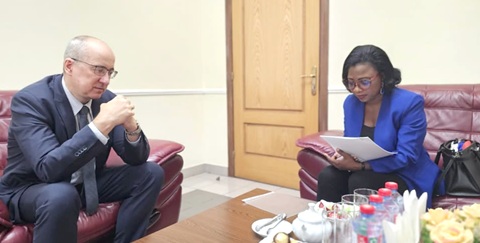
The Russian Ambassador to Ghana, Andrei Ordash (A.O.) , last Thursday granted the Daily Graphic an exclusive interview which touched among others on Russia’s cooperation with Ghana; the upcoming Russia-Africa Summit and Russia’s war with Ukraine.
Excerpts from the interview, especially the aspect on the war with Ukraine and expectations from Ghana have been captured below.
Why does Russia believe its military action in Ukraine is justified and what would Moscow consider a realistic basis for ending the war?
A.O.: In our assessment, this is the result of a systemic crisis in European security that has been developing over many years.
Following the collapse of the Soviet Union, Western states assured us that NATO’s military infrastructure would not advance eastwards by a single inch.
However, these promises were cynically broken.
The alliance expanded repeatedly, incorporating the Baltic states, Poland, Romania and other countries, thereby bringing its bases and missile systems right up to Russia’s borders.
This process culminated in the persistent drive to draw Ukraine – a country with the deepest historical, cultural and kinship ties to Russia – into NATO.
For us, this is not merely a geopolitical dispute. It is a matter of survival.
The deployment of the alliance’s offensive weapons on Ukrainian territory would pose an unacceptable threat to our national security.
Furthermore, since 2014, when a coup d’état took place in Kiev, the West has been deliberately militarising
Ukraine by supplying it with lethal weapons, training its military and effectively turning the country into an anti-Russian springboard.
Russia undertook years of diplomatic efforts to secure the implementation of the 2014–2015 Minsk Agreements – the only document designed to resolve the situation in Ukraine peacefully and safeguard the rights of the Russian-speaking population.
However, the Kiev regime, with the active support of its Western patrons, sabotaged these agreements.
When it became clear that diplomatic channels had been exhausted and the threat to Russia’s security emanating from Ukrainian territory had reached an unacceptable level, Moscow was compelled to decide to launch a special military operation.
Russia considers its actions to be entirely justified, as they are aimed at eliminating existential threats.
The objectives of the special military operation were clearly defined from the outset and remain unchanged.
These are, first and foremost, the demilitarisation and denazification of Ukraine.
Demilitarisation implies a neutral, non-aligned and nuclear-free status for Ukraine, which would guarantee that the country is not used as a springboard for aggression against Russia.
We cannot tolerate a situation where NATO’s military infrastructure and weapons are deployed on our borders.
Denazification is not merely a slogan. It is a struggle against an ideology that has been nurtured for decades in Ukraine, where Russophobia and neo-Nazi sentiments are fostered.
The Russian leadership has repeatedly emphasised that one of the root causes of the conflict is precisely the existence of a Nazi regime in Kiev.
This regime, encouraged and funded by the West, pursues a policy that is hostile not only to Russia but also to the Russian-speaking population.
Its true nature is revealed in numerous war crimes against the civilian population.
As regards a realistic basis for ending hostilities, Moscow’s position is consistent and principled.
We have repeatedly stated that it is impossible to halt the conflict along the current line of contact.
This would merely be a ‘freeze’, which, as we have already seen from the example of the Minsk Agreements, leaves threats to Russia unresolved and fails to address the root causes of the conflict.
A realistic settlement can only be a long-term, reliable and sustainable solution that definitively eliminates the root causes of the conflict.
This means that any peace talks and agreements must strictly take into account the achievement of the objectives of the special military operation, in the first place – demilitarisation, denazification and security guarantees for Russia.
We are open to negotiations, but they must be substantive and lead to a lasting peace, rather than yet another lull that could be exploited to rearm Ukraine, ‘pump it full’ of new weapons systems and then resume the war.
No lasting settlement is possible without recognition of the territorial changes that resulted from the free expression of the will of millions of people and are enshrined in Russian law.
I would particularly like to emphasise that Russia’s special military operation has never been directed against Ukrainian civilians.
On the contrary, Russian troops are doing everything possible to avoid civilian casualties, taking great care to protect the civilian population.
We deliberately refrain from large-scale strikes that could result in mass casualties amongst civilians.
Ghana has publicly supported Ukraine’s soverignty and territorial integrity. How does Moscow take this?
A.O.: We are well aware of Ghana’s official position and regard it as that of a sovereign state.
Ghana, like any other state, determines its own foreign policy and forms its own assessments of international events.
Russia does not expect Ghana to choose between Russia and the West or any other centre of power.
Ghana must be guided by its own national interests.
For our part, we hope that Russia’s position on Ukraine will be heard and considered not only through political statements, but also in light of the arguments that Moscow has consistently put forward.
The Ukrainian crisis cannot be assessed solely through the prism of the territorial issue.
It is necessary to take into account the whole range of circumstances: the development of the European security system, NATO enlargement, the coup d’état in Kiev in 2014, repression against the Russian-speaking population, the conflict in the Donbas, the Minsk Agreements and the subsequent military and political developments in Ukraine.
Furthermore, Russia considers it necessary to speak of a broader concept – equal and indivisible security.
Future relations with Ghana
A.O.: Our countries are continuing their political dialogue, developing trade and discussing energy, education, investment and security issues.
This shows that Russian-Ghanaian relations are not built on the principle of political loyalty: ‘support us – and we will cooperate’.
We are interested in a far more practical question: can specific cooperation benefit both partners?
That is what should be the main criterion.
If Russian technology enables Ghana to generate more electricity, that is in Ghana’s interests.
If an investment project creates jobs and broadens the tax base, that is in Ghana’s interests.
If cooperation in agriculture improves access to fertilisers, food and technology, that is in Ghana’s interests.
If Russian universities and research organisations help to train engineers, scientists, doctors and other specialists, this strengthens Ghana’s human capital.
We do not believe that Ghana should limit its relations with other states for the sake of developing cooperation with Russia.
That is precisely why I would formulate Russia’s proposal to Ghana as follows: we are offering Ghana, first and foremost, additional opportunities: a partnership of equals, the absence of political conditions, the opportunity to cooperate with other countries and the choice of specific Russian proposals based solely on how beneficial they are to Ghana itself.
We would like Ghanaians to be able to say in a few years’ time not merely that Russia is their long-standing friend, but that cooperation with Russia has brought the country specific enterprises, technologies, specialists, investment and new opportunities.
It is precisely this, in our view, that constitutes a partnership which strengthens, rather than restricts, national sovereignty.
