

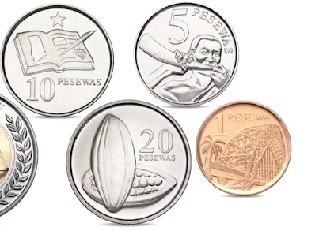
Exactly 12 years ago, that is, the August 8, 2014 edition of this column, I wrote about how using more pesewa coins in business transactions could help control inflation.
In that edition, under the headline "Pesewa-Wise, Saves Cedi," I explained that after the redenomination of the local currency, which had occurred several years earlier, some traders had resorted to rounding up prices to the nearest cedi, creating artificial price hikes not supported by underlying economic fundamentals.
Simply put, for there to be a price increase, that is inflation, there must be some cost- push or demand-pull factors influencing it.
The consideration is based on whether too much money is chasing few goods or whether goods are getting more expensive to make.
When none of these conditions is present and yet prices keep rising, then more probe is needed. It was in response to commentaries in the media on how the rounding up of prices by some traders was pushing up prices that the August 8, 2014 article was written.
In part, this is what I wrote in that article: “The media, it seems, has taken delight in exaggerating the incidence of price jumps.
This is because whereas inflation, which is generally referenced as the increase in the prices of goods and services between periods, is due to a multiplicity of factors, the media is quick to attribute inflation to economic mismanagement. This leaves much to be desired.”
“To defend my statement, I am going to dwell on two main factors, which are the absence of the use of coins in high street transactions and the redenomination exercise conducted a few years back [which led to some traders rounding up prices].
Notes and coins issued by the central bank are ‘legal tender’, which means that if you are living in the country, you are obliged to accept them in fulfilment of payments, unless otherwise agreed between the parties. But what do we see in the country?
We have a situation whereby some of the coins issued by the central bank are not in vogue, meaning they are either rejected by traders or are deemed not good enough for payment for transactions; an illegal act regularised and seemingly accepted as the norm.”
In fact, these were my thoughts in the referenced edition, and I went on further to state the following: “Take the case of the one pesewa coin. Yes, I mean the one pesewa coin. When is the last time that you received one pesewa coin as your ‘change’ after paying for items in the market?
It appears that it is forgotten in the market, but in mainstream supermarkets they appear to be accepted. The net effect of the forgotten pesewa, in part, is the increasing level of inflation in the country.
“For example, the recent increase in fares by commercial drivers, following an agreement with their unions, brought to the fore how the economy of Ghana could be saved from inflation if the pesewa coin was respected and accepted just as the pennies are highly valued in Britain.
Whereas drivers were asked to increase their fares by 17 per cent because of the unwillingness on the part of these operators to accept pesewas, they rounded off the figures and, in the process, short-changed commuters.
For instance, drivers who were charging GH¢0.70 were expected to charge GH¢0.83 maximum (17 per cent increase). But to avoid using pesewas, especially the one pesewa coins, they either rounded it up to GH¢0.85 or some charged as much as GH¢0.90. If a commuter is losing 14 pesewas a day for a round trip, because of the rounding off of the figures, in a year, the loss would be about GH¢50.00.
Now, if about 60 per cent of the active population, say four million people, are losing GH¢50.00 a year, in a year, about GH¢200 million would have been lost through this process.
Now think of how this amount could help develop other sectors of the economy!” This was the commentary in the referenced article 12 years ago. So why have I come back to the same issue after 12 years when inflation looks good, and all the macroeconomic factors are in the right shape?
Well, despite the repeated efforts by the Bank of Ghana to always remind the public about the illegality of rejecting coins, as per recent media reports, the use of coins is still not popular among economic agents in the country. Committed to its mandate, the regulator has stepped in again. And the message, as always, is clear: Rejecting coins is illegal! As was 12 years ago.
In a recent notice, the Bank of Ghana has reminded the public that all cedi notes and coins issued by the central bank are “legal tender”, which means traders, transport operators, and service providers, all economic agents, are obliged, by law, to accept them in payment.
In fact, the bank further warned that the rejection of coins, especially pesewas, undermines monetary policy and fuels inflation. It has ,therefore, directed the public to report any institution or individual refusing coins. Penalties may apply under the Bank of Ghana Act.
This is a timely intervention and as I complained about 12 years ago, we cannot have an economy where legal tender is being ignored. The forgotten pesewa can cost us, as I have explained above.
That “small” rounding has a big macro effect. Therefore, if all of us become pesewa-wise, we will gain more from our hard-earned money through stable prices.
