
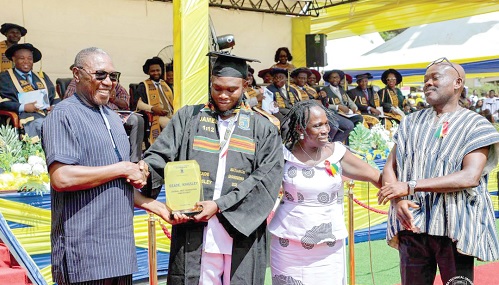
ATU graduates 5,060 at 25th congregation
The Accra Technical University (ATU) has held the second session of its 25th Congregation for graduates of the Higher National Diploma (HND), Bachelor of Technology (B.Tech), master’s, diploma and certificate programmes.
The 5,060 students who graduated in Accra last Friday are part of a total of 7,816 students who completed various programmes at the university for the 2024/2025 academic year.
The graduates were awarded Master of Science and Master of Technology degrees, Bachelor of Technology degrees, Higher National Diplomas, Diplomas and Certificates after successfully completing their respective programmes of studies.
They were made up of 60 master’s students, 935 Bachelor of Technology students, 3,763 Higher National Diploma students, 125 diploma students and 133 certificate students from the Ghana Air Force.
Ceremony
Speaking at the congregation, the Vice-Chancellor of ATU, Prof. Amevi Acakpovi, said the ceremony marked the second session of the university’s 25th Congregation after the first session was held in November 2025.
He explained that the earlier session focused on Bachelor of Technology and Diploma students, while the second session catered for Higher National Diploma students as well as some Bachelor of Technology, master’s, diploma and certificate students whose graduation had to be scheduled later due to regulatory requirements.
Prof. Acakpovi said organising the congregation in two sessions reflected the university’s commitment to academic integrity, quality assurance and regulatory compliance.
He said the total number of graduates for the academic year stood at 7,816, the highest in the history of the university.
The vice-chancellor said the statistics reflected the institution’s gradual transition from a predominantly Higher National Diploma-awarding institution to a technical university with expanded degree programmes.
Reforms
For his part, the Deputy Minister of Education, Dr Clement Abass Apaak, said the government was implementing reforms aimed at preparing graduates for the changing demands of the global economy.
He said the government had reformed the student loan system to improve access to higher education and secured about $300 million from the World Bank to support reforms in education, particularly in technical and vocational training.
Dr Apaak said the government was shifting the country’s education model from one that focused largely on theory to a system that emphasised practical training.
“For too long, our system has been dominated by theory. We are moving from approximately 90 per cent theory and 10 per cent practical training to a model that prioritises 70 per cent practical and 30 per cent theory,” he said.
He said the government was also placing emphasis on digital skills development, including the use of digital learning platforms and artificial intelligence-supported tools.
Dr Apaak added that plans were underway to establish a national innovation and digital jobs hub expected to create more than 200,000 jobs by 2028.
The valedictorian, Kingsley Dzade, described the occasion as a moment of joy and gratitude that marked the end of one journey and the beginning of another.
