
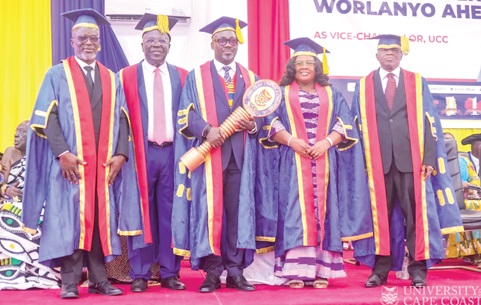
The University of Cape Coast (UCC) has inducted Professor Denis Worlanyo Aheto into office as the 12th Vice-Chancellor of the university.
He takes over from Prof. Johnson Nyarko Boampong, who retired in September last year.
Until his elevation to the high office of the university, the professor of Coastal Ecology and Interdisciplinary Oceans Studies served as Pro-Vice-Chancellor and the Director of the Centre for Coastal Management.
He also headed the UCC’s Africa Centre of Excellence in Coastal Resilience (ACECoR).
Prof. Aheto's achievements at UCC's Centre for Coastal Management include attracting more than $30 million in research funding, supporting over 400 scholarships and supervising the training of more than 50 PhD graduates.
Investiture
The investiture of UCC’s 12th Vice-Chancellor was attended by dignitaries, including the Chancellor of UCC, Sir (Dr) Sam Esoun Jonah; the Chairman of the UCC Governing Council, Justice William Atuguba (retd), a retired Justice of the Supreme Court; past Vice-Chancellors, Vice-Chancellors from other universities — local and abroad, alongside principal officers, staff, students, alumni, traditional leaders and development partners.
The ceremony, which lasted for about four hours, was characterised by rich cultural displays, traditional rites, musical interludes and choral performances from the people of the Volta Region, where the Vice-Chancellor hails from.
Transformational leadership
The 54-year-old Vice-Chancellor pledged to provide transformational leadership anchored on excellence in teaching, research, innovation and service.
He described his appointment as "not merely a personal honour but a solemn call to service," adding that his administration would build "a transformative, inclusive and diverse academic environment that empowers excellence in research, teaching and learning and operates for wider impact on society."
Prof. Aheto outlined a five-pillar strategic agenda centred on financial sustainability, institutional governance, research excellence, digital transformation, improved teaching and learning, diversity and inclusion.
Among the flagship initiatives, he announced plans to establish a College of Engineering and Built Environment, modernise laboratories and lecture facilities, strengthen campus Wi Fi, expand AI integration across the university and improve student accommodation through public-private partnerships.
The Vice-Chancellor said the university would strengthen partnerships with government, industry, alumni and development partners to expand research funding, improve teaching and learning, and increase UCC's global competitiveness.
He announced plans to roll out a fully digital artificial intelligence (AI)-powered e-campus expected to enrol about 10,000 students annually, with the first cohort expected to begin studies during the 2026/2027 academic year.
The professor of Coastal Ecology disclosed that the university had already secured accreditation for 36 new postgraduate programmes, including AI, cybersecurity, as well as environmental sustainability and governance management.
The Vice-Chancellor also announced the establishment of an Africa Ocean Institute to integrate UCC's marine and coastal research centres into a continental hub of ocean research, marine governance and policy engagement.
Additionally, Prof. Aheto said the university had secured approval to establish an Africa Food Integrity Centre to advance research into food authenticity, food safety and fraud prevention, while plans were underway to establish a Centre for Ecological and Terrestrial Sustainability to promote biodiversity conservation and ecosystem restoration across Africa.
Not comfort, responsibility
The Chancellor of UCC, declared that Prof. Aheto had inherited not comfort but responsibility.
"I have not come here to hand you keys. I have come here to hand you a storm," he remarked, charging the new Vice-Chancellor to build "the university that does not yet fully exist."
Sir Sam said universities across Africa should move beyond examination-driven education to capability-based learning, arguing that degrees should become proof of competence rather than certificates of memorised knowledge.
"The world our graduates are entering will not ask them what they know. It will ask them what they can do," he stressed.
Dr Jonah observed that although many African graduates possessed impressive academic qualifications, many lacked the practical competencies required by industry and society.
To reverse that trend, he proposed that UCC should establish Africa's first degree-awarding faculty dedicated to vocational and applied education.
The proposed faculty, he explained, should offer bachelor's and master's programmes in renewable energy systems, aquaculture enterprise, construction, agri-food systems, community health, creative industries and human-AI collaboration.
Under the model, students would graduate only after demonstrating practical competence, with assessments requiring them to solve real-life problems rather than merely describe theoretical concepts.
Sir Sam described the rapid advancement of AI as the greatest disruption universities have faced in centuries, insisting that institutions should rethink the purpose of university education if they were to remain relevant.
The Chancellor described AI as a transformational technology that universities should embrace rather than resist.
Immediate reforms
To position UCC for the future, the Chancellor called for the establishment of a student AI club focused on solving practical community challenges through innovation rather than organising seminars.
He also urged the university to connect students with Ghanaian professionals in the diaspora to provide mentorship through virtual engagements while advocating project-based learning that would require every student to complete practical projects before graduation.
According to him, such reforms would ensure graduates entered the job market with demonstrable skills demanded by employers.
Government support
Speaking on behalf of the Minister of Education, the Director-General of the Ghana Tertiary Education Commission (GTEC), Prof. Ahmed Abdulai Jinapor, described the investiture as a renewal of UCC's commitment to academic excellence, integrity and national development.
He said since its establishment in 1962 to train graduate teachers, UCC had evolved into one of Africa's premier universities with more than 74,000 students and had made significant contributions to research, innovation and human resource development.
Prof. Jinapor urged tertiary institutions to maintain high standards of quality, relevance and academic integrity to ensure graduates possessed the competencies required for national development.
He assured Prof. Aheto of GTEC's support and expressed confidence that under his leadership, UCC would continue to strengthen its reputation as one of Africa's leading universities.
