
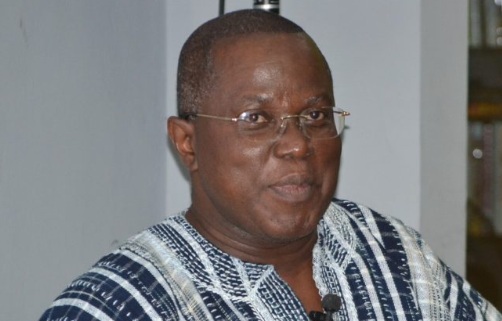
The Chairman of the National Development Planning Commission (NDPC), Dr Nii Moi Thompson, has warned that the excessive concentration of economic activities, population and investment in Greater Accra are worsening flooding and other urban challenges in the capital.
He explained that Greater Accra Region currently contributes about 38 per cent of the country’s Gross Domestic Product (GDP) and attracted approximately 86 per cent of the country's foreign direct investment (FDI), despite occupying only about 1.4 per cent of the nation's land area.
Dr Thompson described the situation as a "perfect storm" in which economic opportunities, investments and population growth had become heavily concentrated in a limited geographical space, placing enormous pressure on infrastructure and the environment.
Appearing before the Parliamentary Committee on Economy and Development in Accra on Tuesday, June 9, 2026, Dr Thompson stated that the region had become the most populous region in the country, with a population density of about 1,680 people per square kilometre compared to roughly 300 people per square kilometre in the Ashanti Region.
"You cannot put the bulk of your population in the smallest land area. Greater Accra, even though it is the smallest region in terms of land area, is now the most populous region among the 16 regions.
“That is like the perfect storm, where every contradiction you can imagine has been put in this little space, and those are the consequences we see; the flooding, the collapsing buildings and everything," he said.
Context
The country has experienced renewed flooding particularly in Accra and its suburbs, where floodwaters submerged homes, disrupted transportation, damaged businesses and displaced residents.
The flooding has also coincided with a series of building collapses in Accra, including incidents at Adenta New Site and Avenor, where rescue operations were mounted to save trapped occupants and fatalities were recorded.
The situation has reignited concerns about poor drainage systems, choked gutters, unregulated construction in waterways and weak enforcement of urban planning regulations, which experts continue to identify as key drivers of the country's recurring flood disasters.
Committee sitting
Dr Thompson appeared before the committee at a public sitting together with the Deputy Minister of Finance, Thomas Nyarko Ampem, and senior officials from the Ministry of Finance (MoF) and its agencies, including the Government Statistician, Dr Alhassan Iddrisu; a Director at MoF, Samuel Danquah Arkhurst; Director, Policy Coordination Monitoring & Evaluation at the MoF, Kwasi Adu; and a Deputy Controller and Account General, Emelia Boatemah Osei Derkyi.
Consequences
The NDPC chairman said the disasters highlighted the consequences of the excessive concentration of people, investments and economic activities in Greater Accra.
He said the consequences of the imbalance were evident in the recurrent flooding, collapsing buildings, traffic congestion and increasing strain on public services in the capital.
Dr Thompson argued that the country's development challenges were rooted in structural distortions that have continued to worsen due to the absence of a long-term national development strategy capable of promoting more balanced regional growth.
He stressed that the NDPC was prioritising measures to address regional inequalities through a consolidated national development plan aimed at encouraging investment and economic opportunities outside Greater Accra.
Dr Thompson added that reducing the overconcentration of people and economic activities in the capital was critical to tackling flooding and ensuring sustainable national development.
Regional inequalities
He said recent multidimensional poverty data had exposed deep regional inequalities, noting that seven of the country's poorest regions were located within the Savannah Belt despite the area accounting for about 54 per cent of Ghana's land mass.
The development economist explained that the disparity highlighted longstanding structural imbalances in the distribution of economic opportunities and development resources across the country.
Dr Thompson stated that the increasing concentration of population, investment and economic activity in Greater Accra was a consequence of the absence of a coherent long-term national development strategy.
He stressed that the NDPC was prioritising a consolidated national development plan to promote balanced regional growth, reduce inequalities and attract greater investment to underserved parts of the country.
Report
Discussions at the meeting centred on the NDPC's 2024 National Annual Progress Report.
The report was the 23rd edition of the Annual Progress Reports and the third assessment of the implementation of policies under the Agenda for Jobs II: Creating Prosperity and Equal Opportunity for All (2022–2025).
It was compiled through an evaluation of key indicators and targets used to monitor the performance of policy and programme interventions carried out under the national development framework during the 2024 fiscal year.
