
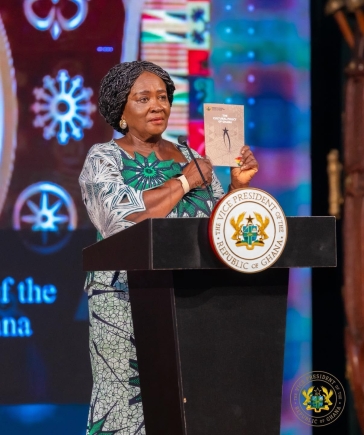
Health workforce key to universal health coverage — Vice-President
The Vice-President, Professor Naana Jane Opoku-Agyemang, has underscored the critical role of health workers in Ghana’s quest to achieve universal health coverage.
She said a resilient workforce remained the bedrock of an effective healthcare system.
Opening the 2026 Annual Health Summit in Accra on Tuesday (June 9), Prof. Opoku-Agyemang stated that while the country had made considerable progress in expanding its health workforce over the years, gaps in distribution continued to leave many underserved communities without adequate access to health professionals.
She said the challenge facing the country was not merely producing more health workers but ensuring the right mix of skills and deploying personnel to areas where they were most needed.
The Vice-President said government initiatives such as the Free Primary Healthcare Initiative, the Ghana Medical Trust Fund also known as MahamaCares, and investments in health workforce development were aimed at strengthening healthcare delivery and advancing health sovereignty.
The summit brought together stakeholders from the health sector in the Greater Accra Region to review performance, assess challenges, and discuss strategies for achieving universal health coverage (UHC).
The summit was held on the theme: “Building a Resilient Health Workforce for the Attainment of Universal Health Coverage.”
Health sovereignty agenda
Prof. Opoku-Agyemang said the country’s health sector efforts were being guided by the broader vision of the Aquarius Set on Health Sovereignty, which seeks to reposition health as an economic investment and a pillar of national security.
She explained that the framework promoted domestic financing, local capacity development and workforce strengthening, while placing health at the centre of national resilience and self-reliance.
Retaining health professionals
On retention of health professionals, the Vice-President said retaining them required a coordinated national response beyond the health sector.
She explained that healthcare professionals were more likely to remain in deprived communities when they had access to decent housing, transportation, security and other essential social amenities.
Prof. Opoku-Agyemang, therefore, called for stronger collaboration among ministries, departments and agencies to create conditions that would encourage health workers to remain in underserved areas.
Reforms
For his part, the Minister of Health, Kwabena Mintah Akandoh, described the summit as timely, saying the country’s health sector was operating within a rapidly changing global and domestic environment characterised by economic uncertainty, demographic shifts and increasing disease burdens.
He said health remained central to the country’s resetting agenda.
Mr Akandoh said the government had uncapped National Health Insurance Scheme funding, launched the Free Primary Healthcare Initiative and established the Ghana Medical Trust Fund to support people living with chronic and life-threatening diseases.
Progress towards UHC
The Minister of Health said the country’s pursuit of UHC had produced measurable results over the years.
Outpatient attendance had risen from 29.9 million visits in 2021 to more than 39 million visits in 2025, while active membership of the National Health Insurance Scheme had increased from 57 per cent of the population in 2021 to 66 per cent in 2026, Mr Akandoh said.
He added that out-of-pocket expenditure on healthcare had declined from 38 per cent to 26.7 per cent of total health spending.
Workforce gains, challenges
Mr Akandoh said Ghana’s public health workforce had tripled between 2013 and 2022, with health worker density increasing from 16.5 to 41.92 per 10,000 population.
He further said the combined density of doctors, nurses and midwives currently stood at 82.75 per 10,000 population.
Despite those gains, he acknowledged persistent inequities in workforce distribution, stating that while 41 per cent of Ghanaians lived in rural areas, only 38 per cent of health workers served those communities.
Employment, specialist training
Mr Akandoh said more than 14,000 health workers were placed on government payroll last year, while plans were underway to recruit an additional 16,000 personnel this year.
He disclosed that only 12 doctors accepted postings to underserved regions in 2024, compared with 100 doctors successfully deployed to such areas in 2026.
Infrastructure expansion
Mr Akandoh said the government intended to complete at least 10 Agenda 111 hospitals this year and subsequently expand the programme with an additional 25 facilities.
He said plans were also underway to engage private sector and faith-based organisations in managing and utilising the facilities.
Meanwhile, Mr Akandoh said work would commence on regional hospitals in Savannah, Oti and Western North regions, as well as three cardiac centres.
