
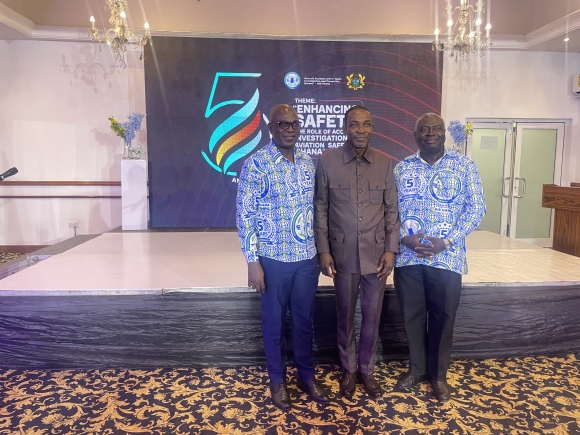
The Acting Director General of the Ghana Civil Aviation Authority (GCAA), Rev. Stephen Wilfred Arthur, has said thorough investigations into aircraft accidents and incidents are critical to strengthening aviation safety, regulatory frameworks, and public confidence, describing such investigations as both a technical and moral obligation.
“Investigation into aircraft accidents and incidents is not merely a technical exercise. It is a moral and professional obligation. It safeguards lives, informs policy, strengthens oversight, and builds public confidence in our aviation system,” he stated.
Rev Arthur made the remarks at the launch of the 5th anniversary celebration of the Aircraft Accident and Incident Investigation and Prevention Bureau (AIB Ghana), on the theme “Enhancing Safety: The Role of Accident Investigation on Aviation Safety in Ghana” in Accra on Monday
He questioned earlier arrangements where the GCAA performed both regulatory and investigative roles, noting that such a setup raised concerns about objectivity.
He asked how “true objectivity can be assured when an institution is required to investigate activities that fall within its own regulatory oversight.”
According said the establishment of AIB Ghana as an independent body aligns with International Civil Aviation Organization (ICAO) standards, ensuring functional independence between accident investigation and regulatory or operational responsibilities.
Achievements
Rev. Arthur highlighted the bureau’s progress over the past five years, including conducting comprehensive investigations, issuing safety recommendations, building investigative capacity, and contributing to both national and regional aviation safety.
He emphasised that the real value of accident investigations lies not in the reports produced, but in the safety improvements that follow.
“The true value of an investigation lies not in the voluminous report alone, but in the safety it improves going forward,” he said.
He further stressed collaboration between AIB Ghana and the GCAA, describing the relationship as complementary rather than adversarial.
He noted that findings from investigations have provided “invaluable input” into Ghana’s State Safety Programme, supporting safety risk management and assurance processes in line with ICAO Annex 13.
Rev. Arthur called for continued investment in training, capacity building, and modern investigative tools to address emerging technologies such as unmanned aircraft systems.
He also urged the development of national procedures for assisting accident victims and their families and reaffirmed the GCAA’s commitment to deepening collaboration with AIB Ghana and other stakeholders.
Investigations
The Minister of Transport, Joseph Bukari Nikpe, also emphasised the importance of AIB Ghana, noting that aircraft accident investigations were previously handled on an ad hoc basis within the civil aviation ministry.
He described the creation of an autonomous bureau as a major milestone for objectivity, transparency, and alignment with international best practices.
He stressed that accident investigations are not about blame but about learning lessons to prevent recurrence.
“Aircraft accident investigation is not about blame or punishment. Every accident thoroughly investigated becomes a lesson learned, and every lesson learned is a life potentially saved,” he said.
Mr Nikpe added that aviation safety is sustained through robust systems, coordinated frameworks, and continuous improvement, rather than merely the absence of accidents.
He called for stronger follow-up on safety recommendations and data-driven policy decisions that translate findings into better regulations, training, procedures, and technologies.
Challenges
Despite the bureau’s achievements, the Acting Commissioner of AIB Ghana, John M.K. Wumborti, acknowledged challenges confronting the institution, including funding constraints, limited access to specialized equipment, and inadequate advanced investigation tools.
He noted that while these challenges have tested the bureau’s operations, they have not deterred its commitment to independent and professional investigations.
Mr Wumborti called for sustained investment, stronger inter-agency collaboration, and continued public education to support a culture of safety learning in Ghana’s aviation sector.
