
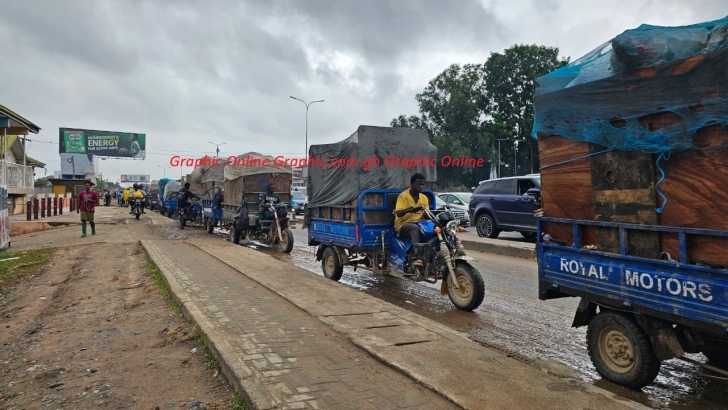
Environmental and local governance experts have called for a ban on informal tricycle operators, popularly known as Aboboya, collecting household waste, arguing that the practice undermines regulated waste management and creates challenges for proper disposal.
They said that while informal operators provide a service to some communities, their activities fall outside the formal waste management arrangements established by metropolitan, municipal and district assemblies, making it difficult to ensure proper transportation and disposal of waste.
Speaking in a radio interview monitored by Graphic Online on Joy FM on Wednesday, July 8, 2026, environmental engineer Dr Juliet Ohemeng Ntiamoah said Ghana could not achieve an effective sanitation system if waste collection was not properly regulated.
She argued that informal tricycle operators often lack the equipment needed to transport waste to approved disposal facilities, increasing the possibility of waste being dumped at unauthorised locations.
"The Aboboya being used for waste collection should be banned and that is something that I think maybe the Ministry of Local Government must step in," Dr Ohemeng Ntiamoah said.
She added that Ghana needed to treat sanitation as a priority by investing more in waste management infrastructure, including engineered landfill sites and recycling facilities.
Dr Ntiamoah also called for stronger regulation of licensed waste management companies, saying there should be mechanisms to sanction operators who fail to provide the services they are contracted to deliver.
"I don't currently know if we have an institution in Ghana that regulates these waste collectors because it shouldn't be the case that waste collectors can decide to show up or not show up whilst they are being paid," she said.
President of the Chamber for Local Governance, Dr Richard Fiadomor, supported the call for action against informal waste collectors, describing their operations as outside the approved arrangements between assemblies and licensed waste management companies.
He explained that under the current system, assemblies enter into franchise agreements with waste management companies to serve specific areas, with fees determined through approved fee-fixing resolutions. According to Dr Fiadomor, some residents have instead turned to informal operators who charge differently from the approved rates, weakening the system established by assemblies.
He said licensed waste companies have equipment, including skip trucks, which enable them to transport waste to disposal sites, unlike many informal tricycle operators who may not have the capacity to move waste over longer distances.
"Because these people are doing that with the connivance of the citizens, I have generated my waste. So if a Zoomlion truck comes and I decide not to give it to the Zoomlion truck, they can't do anything to me," he said.
However, the discussion also highlighted wider challenges within Ghana's waste management sector, including inadequate investment, limited disposal infrastructure and concerns over service delivery by some licensed operators.
Research fellow at the Institute of Statistical, Social and Economic Research, Dr Kwame Adjei-Mantey, said Ghana was underinvesting in waste management, describing sanitation spending as an investment that provides economic benefits through reduced health costs and avoided losses. He said research conducted by ISSER showed that Ghana was investing far below what was required to properly manage waste, stressing the need for increased funding for the sector.
Dr Ntiamoah further argued that flood prevention required attention beyond waste management, noting that silt from unpaved roads contributes significantly to blocked drains and increased runoff during rainfall. She called for improved urban planning, more green spaces and infrastructure that allows rainwater to seep into the ground to reduce flooding risks.
The experts' comments come amid renewed public debate over sanitation and flooding, with calls for a more coordinated approach to waste collection, disposal and drainage management.
