
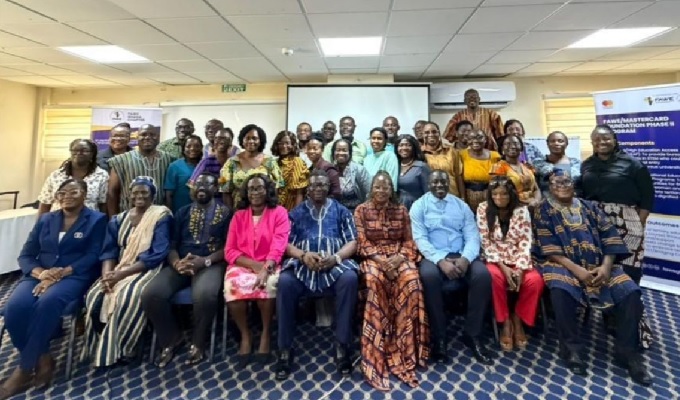
FAWE Ghana Chapter sentises stakeholders on gender responsive teaching approaches
The Forum for African Women Educationalists (FAWE) Ghana Chapter has engaged stakeholders within the education sector on its Gender-Responsive Pedagogy (GRP) platform, a professional development model.
The model focuses on approaches and methodologies that are gender-responsive, addressing the needs of both girls and boys in a fair and dignified manner during teaching, learning, and other school-related activities.
The initiative in partnership with the Mastercard Foundation , formed part of Phase II of its STEM education programme, which aims to equip marginalised and disadvantaged students across the country.
The two-day Popularisation Forum, aims to serve as a strategic entry point to engage key stakeholders, share evidence of FAWE’s GRP4TVET, and advocate for their adoption and approval for use in TVET institutions in Ghana.
Its aims to create awareness of the GRP platform and encourage stakeholders to integrate it into national policy, the national teaching curriculum, and courses in Colleges of Education and universities.
The event brought together officials from the Ghana Education Service, CTVET, the Ministry of Education, NaCCA, teachers, and heads of schools, among others.
The GRP toolkit is a course comprising two parts: GRP 1, which focuses on teaching and learning, and GRP 2, which addresses gender-based violence.
Rationale
In a Presentation , the Programmes Officer, FAWE Ghana, Dora Mochiah, said Responsive Model was developed by the Forum for African Women Educationalists in 2005 to create gender-responsive teaching and learning environments in African schools.
She explained that the model synthesised best practices from recently developed and implemented GRP toolkits, including those from Ethiopia, Uganda, and Rwanda.
She added that it focuses on training teachers to understand and address the specific needs of both girls and boys, while promoting inclusion and enhancing student participation and performance.
She explained that the quality of teaching across all levels of education has a significant impact on the academic access, retention, and performance of girls and boys.
She added that many teachers in sub-Saharan Africa, conditioned by patriarchal values in their communities, employ teaching methods that are not conducive to equal participation of both girls and boys.
At various levels, educational institutions have “cultures” that foster gender inequalities adding these include the teachers' attitudes, the school curriculum, the textbooks used, and educational policies, which are mainly modeled on male perspectives and values.
She said it is a practical tool for training new and seasoned teachers to ensure gender transformative approaches in teaching and learning and creative and participatory activities for creating a gender responsive classroom.
Commitment
The Head of Centre for Business Incubation and Innovation Centre at the University of Skills Training and Entrepreneurial Development (USTD), Dr Lydia Takyi, highlighted the progress made by their institution in advancing inclusive teaching practices across TVET institutions, and called for stronger collaboration and wider institutional adoption.
Dr Takyi said USTD has, over the past three years, implemented its version of GRP, known as Gender Responsiveness and Inclusive Pedagogy (GRIP), with a focus on training faculty and building institutional capacity.
“We realised early on that the change we seek cannot be limited to students alone. We needed to equip educators and institutions with the right tools,” she explained.
According to her, USTD has partnered with about 40 institutions nationwide, dividing the country into operational zones to facilitate the rollout of a comprehensive gender-responsive and inclusive pedagogy manual tailored for Agricultural TVET (ATVET) institutions.
Dr Takyi explained that the initiative deliberately targets male-dominated fields such as engineering and heavy equipment operation, including tractor handling, where female participation has traditionally been low.
“We are working to create environments where women feel comfortable and encouraged to participate in areas previously considered exclusive to men. It is not about fairness alone, but about equity—ensuring everyone has the opportunity to realise their full potential,” she stressed.
She added that the GRP framework seeks to eliminate gender-based discrimination and foster safe, accommodating learning environments for all students, regardless of gender.
Dr Takyi emphasised the importance of institutional buy-in, continuous dialogue, and strategic collaboration in scaling the initiative.
“We recognise that training a limited number of institutions and faculty is not enough. The next step is to cascade the knowledge across more institutions and expand faculty training,” she said.
She said the programme has emphasised the importance was the concept of creating GRP ambassadors within institutions to drive awareness and ensure sustained implementation.
The Director for Policy Planning, Research, Monitoring and Evaluation at the Ghana Tertiary Education Commission (GTEC), Mr John Dadzie-Mensah, said the Commission would review institutional gender policies and accreditation systems to ensure GRP is embedded at all levels of programme design and delivery.
He said GTEC would assess whether existing gender policies adequately address pedagogy and support institutions to integrate gender-sensitive approaches into curricula, course design, and teaching methods.
Mr Dadzie-Mensah urged stakeholders to move beyond policy to implementation, stressing that regulators must ensure institutions translate commitments into practice.
