

Food insecurity rises to 38.1%; 12.5 million Ghanaians struggle to access food – Ghana Statistical Service
Food insecurity in Ghana remains volatile and unevenly distributed, with 12.5 million people affected as of the third quarter of 2025, despite a marginal improvement from earlier in the year, according to the latest Quarterly Food Insecurity Report released in Accra today.
Presenting the report, Government Statistician, Professor Alhassan Iddrisu, said food insecurity is not merely a welfare concern but a critical development challenge with far-reaching implications for the economy and human capital.
“This release is important because food insecurity is not just a social issue,” he said. “It affects household welfare. It affects child health, labour productivity, business confidence and national development.”
The report, which covers the period from the first quarter of 2024 to the third quarter of 2025, is based on data from the Quarterly Labour Force Survey and supports Sustainable Development Goal Two, which seeks to end hunger, improve nutrition and promote sustainable food systems.
“Our goal for this release is very simple, to provide clear, timely and credible evidence that helps stakeholders, including government, businesses, communities and development partners, make better decisions in the food security space,” the Government Statistician noted.
Rising trend despite recent easing
According to the report, national food insecurity prevalence increased from 35.3 per cent in the first quarter of 2024 to 38.1 per cent in the third quarter of 2025, after peaking in the second quarter of 2025.
“This tells us something very important, that food insecurity in Ghana is volatile, and that it responds quickly to economic conditions, to seasonal patterns, as well as surprise movements,” Prof Iddrisu explained, adding that “despite the recent easing we have seen in food insecurity, the overall trend since 2024 quarter one is upward, indicating rising vulnerability”.
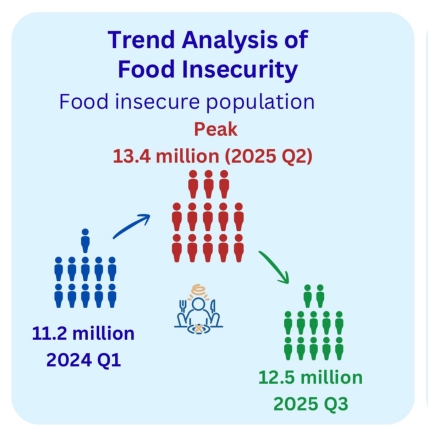
In absolute terms, the number of food-insecure persons rose from 11.2 million in the first quarter of 2024 to a peak of 13.4 million in the second quarter of 2025, before declining to 12.5 million in the third quarter.
“Just within one quarter the number of food insecure persons reduced by 900,723 persons from 13.4 million in quarter two to 12.5 million in quarter three,” he said.
However, he stressed that the figure remains worrying. “Given that in the third quarter of 2025 the number of people who are food insecure is 12.5 million people, that number is still very, very significant, and as a country, we have to do everything possible to ensure that that number is reduced to the very minimum.”
How food insecurity is measured
The Ghana Statistical Service uses the Food Insecurity Experience Scale (FIES), which is aligned with SDG indicator 2.1.2 and allows for international comparison.
“This approach asks households eight simple questions about their experiences over the last three months,” Prof Iddrisu said. “These questions include, ‘Did you worry about having enough food? Did you eat less than you should have? Did you skip meals? And did anyone go a whole day without eating?’”
Households that respond “no” to all eight questions are classified as food secure, those who answer “yes” to four to six questions are moderately food insecure, while those who answer “yes” to seven or eight questions fall under severe food insecurity.
Sharp gender and regional disparities
The report shows persistent gender gaps, with female-headed households consistently more affected.
“From 2024 quarter one to 2025 quarter three, moderate food insecurity was consistently higher in female headed households,” Prof Iddrisu said, noting that the gap widened to 6.2 percentage points in the third quarter of 2025.
“This possibly reflects structural factors such as income differences between males and females, employment opportunities and also caregiving responsibilities,” he added.
Regional disparities were described as “among the strongest findings” of the report. The Upper West Region recorded the highest food insecurity prevalence at 55.9 per cent, followed by the Volta Region at 50.1 per cent and the North East Region at 45.9 per cent.
“If at the national level food insecurity prevalence rate is 38.1 per cent and you have a region like Upper West that records 55.9 per cent, then you know it is high compared to the national average,” the Government Statistician said.
By contrast, the Oti Region recorded the lowest prevalence at 18.4 per cent in the third quarter of 2025, widening the gap between the best- and worst-performing regions to 37.5 percentage points.
“This tells us that food insecurity in Ghana is deeply spatial, not evenly spread,” he stressed.
Rural households and vulnerable groups hardest hit
Rural households were found to be more vulnerable than urban households, particularly in terms of anxiety about food availability.
“Nationally, about 53 per cent of households reported worrying about food in the third quarter of 2025,” Prof Iddrisu said. “The problem is more severe in rural areas… about 60 per cent compared to 48 per cent in urban areas.”
Household composition also played a significant role. Food insecurity was highest among households with both children and elderly members, averaging 44 per cent in the first three quarters of 2025.
The link between food insecurity and child nutrition was described as “very striking”.
“Nationally, households with malnourished children recorded food insecurity rates of around 44 per cent,” he said.
More alarming was the situation among rural, female-headed households with underweight children, where food insecurity “exceeded 80 per cent in the third quarter of 2025”.
“This is not just a food issue, it is a human capital issue with long term implications for learning, productivity and health,” Prof Iddrisu warned.
Education as a protective factor
Education emerged as one of the strongest buffers against food insecurity.
“Food insecurity declined steadily as educational attainment increased,” the Government Statistician said, noting that households with no education recorded prevalence rates of about 50 per cent, compared with about 15 per cent among households with tertiary education.
“Education matters a lot in addressing food insecurity issues,” he emphasised.
Severe food insecurity eases slightly
Severe food insecurity declined marginally at the national level from 5.1 per cent in the second quarter of 2025 to 4.6 per cent in the third quarter.
However, it remained highest among rural, female-headed households, where it peaked at 8.1 per cent earlier in the year.
“Even when severe deprivation is relatively low, widespread moderate insecurity still affects daily life,” Prof Iddrisu cautioned.
Overlap with poverty and unemployment
The report also highlighted what it described as a “triple burden” of food insecurity, multidimensional poverty and unemployment.
Between the second and third quarters of 2025, the number of people facing all three challenges increased by 19,455 persons, representing a 9.4 per cent rise.
“Although the number is modest, it represents deep structural vulnerability,” the Government Statistician said.
Recommendations and regional comparison
To address the challenges, the report recommends that government targets high-burden regions, expands nutrition-sensitive social protection, links food security interventions to job creation, and invests in education and rural resilience.
Civil society organisations were urged to support vulnerable groups and strengthen community livelihoods, while development partners were encouraged to scale up targeted financing, support gender-responsive programmes and invest in data systems.
Despite the challenges, Prof Iddrisu said Ghana compares favourably with several countries in the sub-region.
“In 2023 for example, Nigeria’s food insecurity prevalence rate was 74.8 per cent, Kenya 73.9 per cent, Ethiopia 61.4 per cent,” he said. “If you compare this to our 38.1 per cent… I think Ghana is doing pretty well.”
He noted, however, that countries such as Egypt, South Africa and Brazil have recorded lower rates.
Appreciation
Before closing, the Government Statistician expressed gratitude to households who participated in the survey, field officers, the Government of Ghana, the World Bank, the media and staff of the Ghana Statistical Service.
“At the Ghana Statistical Service, we’ve been committed to producing timely, accurate, relevant, credible statistics that support Ghana’s development,” he said.
