
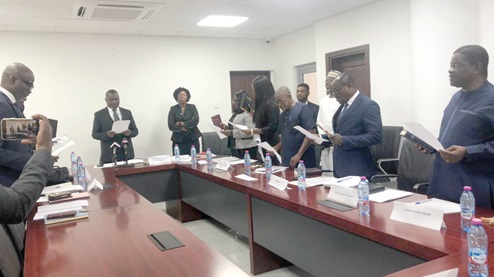
A-G inaugurates Law Reform Commission Board - Charges members to be innovative
The Attorney-General and Minister of Justice, Dr Dominic Akuritinga Ayine, has charged members of the Law Reform Commission Board to adopt innovative and proactive approaches in reforming the country’s laws to meet contemporary social and economic needs.
He said the Law Reform Commission remained a critical institution in the country’s democratic and governance architecture, adding that many landmark post-independence legislations were products of its work.
“Law is not static; it must be dynamic and respond to the problems of our society,” he said, urging the board to ensure that existing laws were reviewed and gaps addressed to support national development.
Dr Ayine gave the charge when he swore in members of the Governing Board of the Law Reform Commission in Accra last Wednesday.
The nine-member board is chaired by a Supreme Court Judge, Janapare Adzua Bartels-Kodwo, and include Victor Kwadjoga Adawudu, Marian Karina Nanorki Darlington and Fredrica Sala Iliasu.
The rest are Godwin Adagewine, Mark Ziwu, Professor James Baba Abugre, Kweku Ansa Asare and Baba Sadique Zankawah.
Functions
The Law Reform Commission, established under NRCD 325 (1975), is mandated to promote the systematic development, modernisation and reform of both statutory and customary laws.
Its primary functions include researching legal anomalies, repealing obsolete enactments, simplifying laws and advising government bodies on law reform.
Innovation
Dr Ayine said the commission’s role had become even more crucial at a time when the government was undertaking a broad reset of state institutions and democratic foundations.
He urged the board to think “outside the box” in carrying out its mandate, adding that innovation would be key to identifying deficiencies in current laws and aligning them with modern realities.
“If you are very innovative and you think out of the box, there are resources out there that can be mobilised to support your work,” the Attorney-General said.
Constitutional review role
Dr Ayine also touched on the commission’s expected role in the implementation of constitutional reforms following the submission of proposals by the Constitution Review Committee.
He said the Constitution Review Implementation Committee, to be announced soon, would work closely with the Law Reform Commission to translate accepted proposals into law.
The Attorney-General explained that while entrenched provisions of the Constitution would require a referendum, non-entrenched provisions would be implemented through legislative amendments in Parliament, with the commission playing a central role in the process.
Govt commitment
Acknowledging challenges such as funding constraints and limited logistics, the Attorney-General said the government remained committed to supporting the commission to deliver effectively on its mandate.
Dr Ayine encouraged the board to develop clear programmes and cost them appropriately to facilitate resource mobilisation.
Gratitude
In her remarks, the Chairperson of the Governing Board expressed gratitude for the confidence reposed in the members.
Justice Bartels-Kodwo pledged their commitment to the task ahead.
She said the board would approach its mandate with dedication, with the aim of aligning the country’s laws with national development priorities.
“We will do all that it takes within our capacity to reform the laws of this country to align with the agenda of the nation,” Justice Bartels-Kodwo said.
