
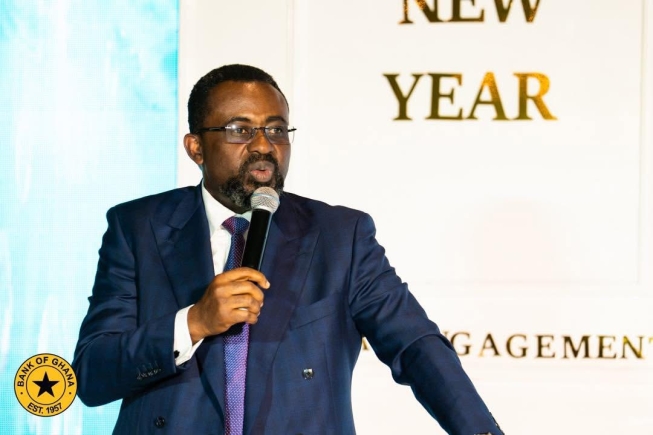
BoG sets agenda for consolidation after economic gains
The Bank of Ghana (BoG) will, this year, transition from crisis-driven interventions to a consolidation phase with the aim of entrenching macroeconomic stability and institutional credibility.
The approach follows a year of implementing difficult but necessary policy adjustments to stabilise the economy, rebuild policy credibility, restore order in the financial system, and anchor inflation expectations after a prolonged period of macroeconomic stress.
The impact of the first leg of the bank’s interventions includes a steady decline in inflation from 23.8 per cent in December 2024 to 5.4 per cent by the end of December 2025, as disciplined monetary tightening, effective liquidity management, and clear policy communication helped to ease price pressures throughout the year.
Consequently, the central bank said this year, it would focus on embedding recent policy reforms into everyday practice to support sustained confidence in the economy.
Speaking at the inaugural Governor's New Year Media Engagement in Accra last Friday, the Governor of the BoG, Dr Johnson Pandit Asiama, stated that monetary policy would remain cautious, data-driven and forward-looking, with an emphasis on consistency rather than quick fixes.
“Now that stability has been restored, our task in 2026 is to consolidate the gains and ensure they deliver lasting confidence in the market,” Dr Asiama said.
Engagement
The engagement was aimed at strengthening ties with the media.
It offered the opportunity for editors and senior journalists in the country to interact with senior officials of the central bank, including the Governor, the First Deputy Governor, Dr Zakari Mumuni, and the Second Deputy Governor, Matilda Asante-Asiedu.
The event was also attended by the President of the Ghana Journalists Association (GJA), Albert Kwabena Dwumfour, the President of the Ghana Independent Broadcasters Association (GIBA), Abdulai Awudu, the President of the Private Newspapers and Online News Publishers Association of Ghana (PRINPAG), David Sitsofe Tamakloe, and the acting President of the Institute of Financial and Economic Journalists (IFEJ), Roger Agana.
Price recovery
Dr Asiama stated that the central bank supported greater use of public markets in 2025 to strengthen governance, transparency and market discipline across the financial sector, while introducing a rules-based foreign exchange framework to restore order and curb abuse.
He said those reforms improved price discovery and confidence in the foreign exchange market, supported by the domestic gold purchase programme, which helped to moderate exchange rate pressures and rebuild external buffers.
As a result, the Governor said, gross international reserves rose to more than $13.8 billion, equivalent to about 5.7 months of import cover.
“I have not seen such levels since I joined the central bank in 1995,” he said.
Firm footing
The Governor stressed that the passage of the Bank of Ghana (Amendment) Act in 2025 strengthened the bank’s independence and accountability, placing the country’s central banking framework on a firmer footing in line with international best practice.
He said the reforms also reinforced safeguards around central bank financing of the government, which he described as critical to preventing a repeat of past fiscal excesses.
“If we had these amendments in place earlier, the outcomes would have been different, and some of the painful adjustments we experienced could have been avoided,” Dr Asiama added.
Be circumspect
Stressing the importance of responsible reporting, Dr Mumuni urged media practitioners to be circumspect in their coverage to safeguard financial market stability.
He said the public relied heavily on media reports to make decisions, placing a significant responsibility on media professionals.
"In this environment, the media is not merely an observer of economic development or events; you are a transmitter of confidence, a shaper of sentiment and often unknowingly, a participant in market dynamics," he said.
For her part, Mrs Asante-Asiedu expressed the commitment of the bank to promote economic and financial journalism through the Governor's Economic and Financial Story of the Year Award.
Capacity-building
The GJA president stressed that tackling misinformation and disinformation in the media required close collaboration to promote accurate reporting, supported by targeted capacity-building initiatives.
“We need rapid response mechanisms to fact-check information before publication, so that journalists can reliably inform the public and strengthen trust in your institution,” he stated.
He urged the bank to expand training beyond financial reporters to include editors and political show hosts, highlighting the media’s role as a bridge between the government and citizens.
“I commend the Bank of Ghana and its Governor, Dr Johnson Pandit Asiama, for restoring fiscal discipline and achieving historic single-digit inflation, while also stabilising the cedi against the dollar,” he added.
