Break trade barriers to unlock West Africa’s economic potential — Chief of Staff
The Chief of Staff, Julius Debrah, has called for coordinated action from West African governments, the private sector and development partners to address trade barriers and unlock the economic potential of businesses.
He said that despite structured policies from various governments in the sub-region, issues such as inadequate logistics and transport infrastructure, fragmented standards and regulatory regimes, limited SME access to finance, high trade costs, and ongoing delays at ports and along trade corridors continued to hinder intra-regional trade.
Mr Debrah said the government alone could not deliver this transformation and, therefore, urged business groups such as the Association of Ghana Industries (AGI) and the Ghana National Chamber of Commerce and Industry (GNCCI) to take a lead role in advocacy, investment mobilisation and enterprise development.
"Let us build robust systems, develop a new trade architecture and renew our commitment to competing effectively across Africa and globally.
"Together, we can transform West Africa into a dynamic, integrated and prosperous economic region," he said.
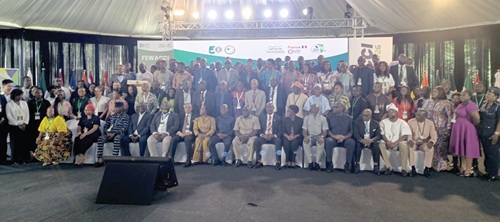
The Chief of Staff was addressing a two-day summit organised by the Federation of African Chambers of Commerce and Industry, on the theme: " Unlocking West Africa’s economic potential through trade, investment, logistics and youth empowerment.”
In attendance were sector ministers, development partners, academics, and youth entrepreneurs, among others.
Infrastructure
Mr Debrah also said that without efficient corridors, reliable roads and digital trade platforms, West African economies would struggle to compete.
He added that Africa’s young population must be turned into an economic advantage through targeted entrepreneurship, innovation and inclusion programmes.
The Chief of Staff also advocated investment in productive capacity and value addition, the empowerment of SMEs and youth, and the enhancement of public-private collaboration.
New order
Senior Partner at AB and David Africa, David Ofosu-Dorte, called on lawmakers and regional bodies to confront the continent’s historical fragmentation, tracing trade patterns back to decisions made at the Berlin Conference of 1884–85, and reconsider trade rules that now limit intra-African commerce.
He questioned whether policies that criminalise certain cross-border movements as “smuggling” were still appropriate in an era prioritising intra-African trade.
"When governments restrict imports within West Africa, they must engage meaningfully with the business community to ensure such measures support rather than stifle regional integration and growth.
"The shift from extra-African to intra-African trade must be taken seriously,” he said, calling for deliberate reforms to unlock the region’s potential,” Mr Ofosu-Dorte added.
He said the private sector must be involved in policy design and implementation if West Africa was to attract the right kind of investment that added value, scaled across borders and created jobs.
Alignment
The President of the federation, Faman Touré, said integration must be experienced in factories, ports, markets and daily business operations.
That, he said, required stronger alignment between public policy and private investment, regional ambition and national implementation and institutional frameworks and business realities.
Mr Touré said his outfit was undergoing a strategic transformation by repositioning the federation as a platform for regional business mobilisation, a facilitator of trade and investment partnerships and a driver of concrete private-sector-led initiatives.
For his part, the President of the Ghana National Chamber of Commerce and Industry, Stephane Miezan, said it was important for countries in the sub-region to redefine their approach to trade and development to build a more resilient and self-sustaining regional economy.