
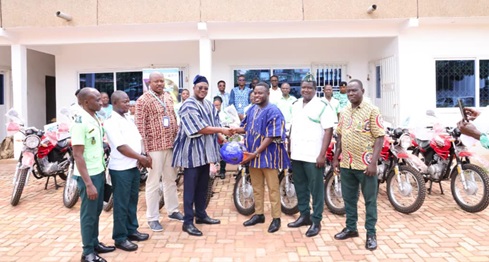
CRS supports National Ambulance Service with motorcycles
Studies have shown that delays in accessing emergency care, often due to poor transportation and weak referral systems, remain a leading cause of maternal deaths in rural areas, with more than 70 per cent of emergency referrals in such areas not completed.
In northern Ghana, the situation is particularly dire, as many expectant mothers face long distances to health facilities, poor road networks, and inadequate emergency transport options.
These barriers often lead to preventable maternal and neonatal deaths.
Motorcycles
To help address these challenges, the Catholic Relief Services (CRS) has donated 10 motorcycles to the National Ambulance Service (NAS) to enhance emergency response for maternal and child health cases across the northern part of the country.
The motorcycles are expected to boost community-level outreach, improve emergency referral coordination and support ongoing maternal and child health initiatives in 10 districts across the Northern, North East, Savannah, and Upper East regions.
The gesture formed part of the Holistic Opportunities for Positive Engagement in Maternal and Child Health (HOPE-MCH) Project.
Funded by the Church of Jesus Christ of Latter-Day Saints, the $3.5 million initiative covers 10 districts across four regions —Northern, North East, Savannah, and Upper East, focusing on strengthening community-based health systems, renovating key health facilities, and donating motorcycles to improve health outreach and referral services.
Presenting the motorcycles on behalf of the CRS Ghana Country Representative, the Monitoring, Evaluation, Accountability, and Learning (MEAL) Coordinator at CRS, Daniel Yakuba, said the motorcycles would enable NAS to extend its services beyond health facilities, ensuring that life-saving care reaches those who need it most.
The initiative, Mr Yakuba said, formed part of CRS’s holistic strategy to address the delays in seeking, reaching and receiving quality maternal care.
Receiving the donation, the Deputy Chief Executive Officer of the National Ambulance Service, Dr Patrick Inkoom, said, “With these motorcycles, our teams can better respond to emergencies in hard-to-reach communities, train local responders and coordinate life-saving interventions at the grass-roots level.”
Writer's email:
