
Don’t hoard educational materials meant for schools - Education Minister cautions directors
The Minister of Education, Haruna Iddrisu, has cautioned regional and district directors of education against hoarding educational materials in stores, instead of distributing them to schools for the benefit of students.
He said such practices could deny pupils and teachers the resources needed to improve teaching and learning outcomes, especially in underserved areas, emphasising that educational materials were procured with public funds and must be used for their intended purpose.
To that end, he said he would soon embark on unannounced inspections, and anyone found culpable would be sanctioned.
BSTEM equipment
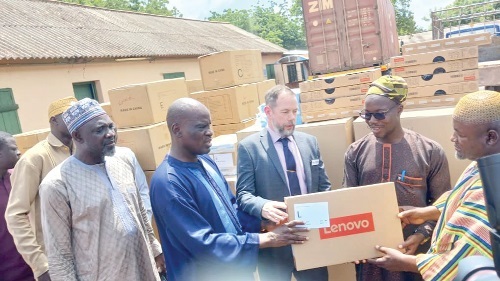
Mr Iddrisu made the call when he presented a large quantity of basic science, technology, engineering and mathematics (BSTEM) equipment to 86 schools in the Northern Region as part of efforts to enhance science and technology education.
The equipment distributed to the beneficiary schools includes science equipment such as beakers, conical flasks, electricity and electronics kits, magnets, measuring cylinders, ray box and lenses kits, safety goggles, spirit burners, thermometers, spring balances, science activity manuals, laptops and others.
Launched in August this year, the BSTEM Programme formed part of the government’s reset agenda and aims at revolutionising science, technology, engineering and mathematics for teachers at the basic school level with emphasis on the areas of coding, AI, renewable energy and robotics, among others.
The project targets 8,800 teachers, with 4,400 beneficiary schools to be resourced with the necessary skills to make learning exciting.
Commitment
Mr Iddrisu said the intervention formed part of the government’s commitment to strengthening STEM education at the pre-tertiary level to equip learners with practical and problem-solving skills relevant to the 21st-century job market.
He said BSTEM education was critical to building a generation of innovators, engineers, scientists and technologists who could drive Ghana’s industrial transformation and socio-economic growth.
He added that without a strong foundation in science and technology, the nation’s quest for accelerated development would remain a challenge.
STEM centres
The minister hinted at plans to establish well-resourced regional STEM centres and innovation hubs to provide continuous hands-on learning opportunities for students and teachers.
These centres, he explained, would serve as incubation points for creative ideas and scientific experiments, enabling learners to apply theoretical knowledge to real-world situations.
Mr Iddrisu urged school heads and teachers to ensure the equipment was properly maintained and used solely for teaching and learning.
He also encouraged students to take advantage of the materials to develop curiosity, creativity and confidence in pursuing science and technology-related careers.
Pledge
The Regional Director of Education, Alhassan Alidu Jnr, pledged to ensure that the items were put to good use to improve the quality of teaching and learning in beneficiary schools across the region.
He said the intervention had come at an opportune time when many basic schools were in dire need of science and technology materials for practical lessons to make teaching more interactive and effective, adding that “the regional education directorate would closely monitor the use of the equipment to ensure accountability and sustainability.”
Mr Alidu commended the Ministry of Education for prioritising the Northern Region in the BSTEM distribution, describing the gesture as a major boost to the government’s efforts to bridge the educational resource gap between northern and southern Ghana.
He also advised teachers and school administrators to handle the items well and incorporate them into daily classroom activities to stimulate students’ interest in science, technology, engineering and mathematics.
Writer’s email:
