
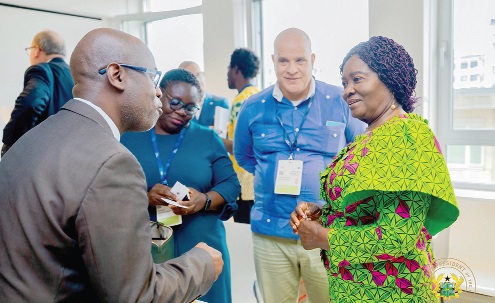
Government committed to transforming cocoa sector - Vice-President tells Brussels Global Forum
The Vice-President, Professor Naana Jane Opoku-Agyemang, has said the government is committed to transforming the country’s cocoa sector from one dependent on raw bean exports to a dynamic cocoa economy that creates jobs, empowers farmers and drives industrial growth.
She said Ghana’s vision was to ensure that the wealth generated from cocoa benefited the very people who cultivated it, namely the farmers and their communities.
“Ghana is clear about the road ahead. We must move beyond exporting raw beans to building a cocoa economy that empowers our farmers, creates jobs, develops industry and upholds sustainability,” she stated.
She was speaking at the EU Sustainable Cocoa Initiative on the final day of the Global Gateway Forum in Brussels.
Prof. Opoku-Agyemang called on global partners to work together towards a fairer, more inclusive cocoa sector that benefits both producers and consumers.
“The EU Sustainable Cocoa Initiative can be a partner in this journey by supporting investment in processing, unlocking financing for cooperatives and small and medium-scale enterprises (SMEs), and ensuring that sustainability standards are inclusive and not punitive,” she urged.
“Let us build a cocoa sector that not only sweetens the world’s palate but also enriches the lives of the farmers and communities who make it possible,” she said.
Forum
The EU Sustainable Cocoa Initiative and the Global Gateway Forum assembled heads of state, policymakers and industry leaders to discuss how sustainable partnerships can drive economic growth, responsible trade and environmental resilience across global value chains.
Economic strength
Vice-President Opoku-Agyemang explained that for Ghana, processing more cocoa at home was both a legitimate aspiration and a strategic imperative, as true economic strength lay in value addition.
She highlighted that local processing created jobs, boosted industrial capacity, enhanced negotiating power and reinforced Ghana’s economic sovereignty.
Prof. Opoku-Agyemang stated that the government’s Free Zones and Investment Promotion frameworks had already expanded installed processing capacity to about half a million tonnes, supported by improved logistics, reliable energy supply, and a more enabling business environment.
“The greatest returns in finance, employment and skills will come when we move into finished products, including chocolate and other cocoa-based products,” she added.
Global trade, challenges
The Vice-President emphasised that the African Continental Free Trade Area (AfCFTA) offered a unique opportunity for Ghana to build regional value chains that retain more wealth on the continent.
She commended the EU’s engagement in cocoa sustainability. However, she pointed out that financing remained one of the biggest challenges to achieving large-scale local processing.
“Investments have often been concentrated in state-owned or multinational facilities while local private actors face high capital requirements and limited access to affordable credit,” she stated, calling for structured blended financing models that integrated capital investment with affordable working capital, risk-sharing mechanisms and technical support to reach even small rural processors.
Prof. Opoku-Agyemang also raised concerns over trade barriers, adding that while tariffs on raw cocoa beans were often zero, duties rose significantly on processed goods such as cocoa powder and chocolate — a system that discouraged value addition in producing countries.
“Addressing these tariff escalations is critical for fair trade,” she stressed.
LID Policy
Prof. Opoku-Agyemang also reaffirmed Ghana’s commitment to improving farmer livelihoods through the Living Income Differential (LID) policy — an initiative jointly introduced with Côte d’Ivoire to ensure cocoa farmers receive fair returns for their labour.
“Our farmers deserve a decent standard of living. The Living Income Differential signals our shared commitment to making that a reality,” she said.
She explained that these reforms aligned with Ghana’s broader industrial transformation agenda, including the Big Push Initiative, which focused on agro-industrial infrastructure, and the Connect 24 Pillar of the government’s 24-hour Economy aimed at ensuring a seamless flow of goods, energy and data.
