
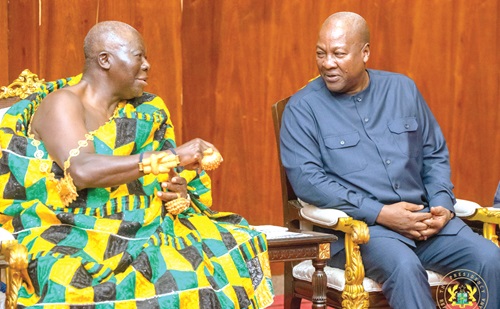
The Asantehene, Otumfuo Osei Tutu II, will hand over his comprehensive report and recommendations on resolving the protracted Bawku chieftaincy conflict to President John Dramani Mahama next Tuesday, December 16, in a development hailed as a potential turning point for the violence-ravaged northern Ghanaian town.
The presentation, set for 4pm at the Presidency in Accra, caps months of intensive mediation efforts led by the revered Ashanti king, who was tasked by President Mahama earlier this year to broker peace between the warring Kusasi and Mamprusi factions. The initiative, launched in April with initial meetings involving representatives from both sides, hit a brief snag before resuming in May, fostering a fragile calm that has allowed some normalcy to return to the area after years of bloodshed and disruption.
Felix Kwakye Ofosu, Member of Parliament and spokesperson to the President, confirmed the upcoming handover in a statement issued on Tuesday, December 9, from the Office of the President. The document emphasised the significance of the Asantehene's role in steering the dialogue towards a sustainable outcome.
The final round of talks, held behind closed doors at the Manhyia Palace in Kumasi last week, unfolded under an ironclad security blanket, with military armoured vehicles and scores of police and soldiers deployed at key vantage points around the palace grounds to forestall any unrest. Leaders from the Kusasi and Mamprusi groups, flanked by their legal teams and supported by throngs of tribespeople both within and beyond the venue, engaged in roughly five hours of deliberations with Otumfuo Osei Tutu II.
As the session wrapped up, an air of cautious optimism permeated the atmosphere, evidenced by the exuberant celebrations that broke out among hundreds of attendees from each faction upon their departure. Supporters from both sides erupted in cheers, honking vehicle horns and revving motorbike engines, with many proclaiming their group's triumph in the process. In a striking display of thawing tensions, lawyers representing the rival parties mingled freely outside, exchanging smiles and handshakes in what observers described as the most promising indicator yet of a viable resolution.
A source privy to the closed-door exchanges revealed that the Asantehene refrained from pronouncing a clear victor or vanquished, in keeping with the collaborative spirit of mediation rather than adversarial litigation. The insider noted that Otumfuo used the occasion to meticulously revisit every contention raised by the factions since the process began. "More importantly, the Asantehene announced that he would present his findings to President John Dramani Mahama for the next steps," the source stated.
The report, expected to outline a clear roadmap for enduring peace, arrives at a critical juncture for Bawku, a once-thriving border municipality in the Upper East Region that has been scarred by intermittent clashes rooted in a long-simmering chieftaincy dispute. Since November 2021 alone, the violence has claimed more than 300 lives, inflicted widespread property damage, and left countless others maimed or displaced. The toll has extended far beyond the immediate human cost, transforming the community into a shadow of its former self and stalling economic activity across multiple fronts.
Schools stand half-empty as terrified pupils and educators shun classes, healthcare centres operate at reduced capacity with nurses and doctors fleeing to safer districts, and local markets languish under the weight of fear-driven boycotts. Businesses have shuttered, investors have retreated, and essential services in trade, finance, and transport grind to a halt amid sporadic gunfire and killings. Curfews have become a grim routine, uprooting livelihoods and exacerbating poverty for thousands of residents caught in the crossfire of ethnic rivalries that date back decades.
The Asantehene's intervention has been viewed as a beacon of hope in this bleak landscape, leveraging his stature as a custodian of traditional authority to facilitate talks that previous state-led attempts had struggled to sustain. While the mediation has not erased all friction, it has undeniably dialled down the intensity of confrontations, offering a glimmer of stability that Bawku's weary populace desperately craves.
Yet the peace process teetered on the brink of derailment during Monday's events, when a spontaneous flare-up outside the Manhyia Palace nearly spiralled into outright violence. The incident was triggered as a bus ferrying Mamprusi participants pulled away from the main entrance, its occupants waving enthusiastically to kin gathered nearby in a burst of post-meeting elation. The gesture ignited fury among adjacent Kusasi supporters, whose mounting agitation threatened to boil over into a brawl as emotions ran high on both ends.
Swift intervention by police and military units quelled the standoff, averting what could have been a disastrous coda to the day's progress. The episode, which lasted about 45 minutes, postponed the Kusasi delegation's exit until reinforcements had restored order, after which they departed to the acclaim of their own swelling crowd.
With the report now bound for the President's desk, stakeholders express guarded optimism that its proposals could pave the way for an amicable settlement, potentially dismantling the structural grievances at the heart of the feud. As Ghana grapples with the broader implications of such ethnic divisions, the outcome of this royal-led endeavour could set a precedent for addressing similar flashpoints nationwide.
