
Cultural diplomacy at play as smock becomes sensation at AU Summit - Demand increases among attendees
The traditional smock, also known as Batakari or Fugu, has become a sensation at the 39th African Union Summit in Addis Ababa, Ethiopia.
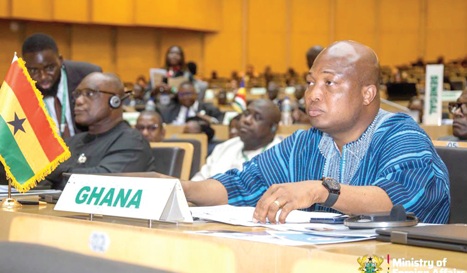
The garment worn by the Minister of Foreign Affairs, Samuel Okudzeto Ablakwa, and the Deputy Education Minister, Dr Clement Abass Apaak, at the AU Summit, sparked interest among diplomats and attendees, with several expressing interest in ordering and purchasing the smock.
The smock, a symbol of Ghanaian cultural heritage, was initially misunderstood by Zambian social media users, who described it as a "blouse".
The push back from Ghanaians, who expressed pride in the traditional outfit in defence of their cultural heritage, has heightened the demand for the smock not only in Ghana, but across Africa.
Mr Ablakwa, who led the smock ambassadorial charge at the summit, was elegantly attired in a blue smock, making him stand out among his colleague foreign ministers of AU member states on the opening day of the 48th Ordinary Session of the Executive Council at the summit on Wednesday, February 11, 2026.
The Deputy Education Minister also joined the campaign the next day, Thursday, February 12, 2026, appearing in his yellow and black woven smock and cap, which was visibly admired by the summit attendees and diplomats.
The tête-à-tête witnessed by the Daily Graphic often ended with all smiles, while the admirers pointed at the beautifully woven smock and gracefully adorned by Mr Ablakwa and Dr Apaak.
Interest
In an interview with the media, Mr Ablakwa confirmed the strong interest shown by his colleagues in the Ghanaian smock, adding that presentations of the garment were expected to be made to selected ministers and heads of state.
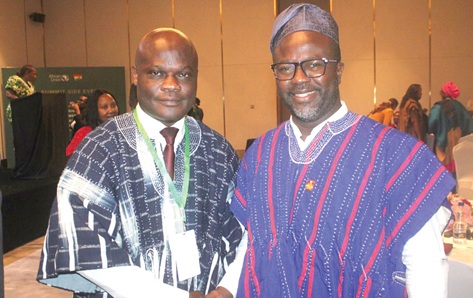
Ahmed Ibrahim (left), the Minister of Local Government, Chieftaincy and Religious Affairs, and another Ghanaian in their smock at the AU Summit
“They were willing to wear more.
The fugu is in such high demand that I hope that our young entrepreneurs, the fugu weavers, will take full advantage of that.
“Indeed, virtually all the foreign ministers have asked that I do a presentation to them at the next meeting.
If I knew that it would be in such high demand, I would have come with truckloads of fugu.
But it's not too late,” he said.
He indicated that at the mid-year meeting of ECOWAS foreign ministers, a request had been made for him to supply the smock in each country’s national colours to the ECOWAS foreign ministers and heads of state, a special assignment he was charged with.
The minister added that next month, a “fugu and kente” exhibition would be held in Zambia to popularise the traditional outfits and their history, while also forming great cultural ties with Zambians.
“We're going to have a huge trade fair.
They've given us the biggest trade exhibition centre.
That's where we are going to do the fugu and kente exhibition,” he said.
Momentum
The minister underscored the need for the country, especially the Ghanaian foreign missions, to take advantage of the present momentum, which he described as “very good internationally”, to promote Ghana-made products.
“I've instructed all our ambassadors and high commissioners that with the coming national day celebrations, the 6th of March, they should all organise a “Fugu and Kente Fair” so that we can all ride on the international momentum positively. It's good for economic diplomacy,” he said.
He urged Ghanaians at home and abroad to continue to promote “Made in Ghana” goods as well as expose Ghanaian fabrics and beautiful cultures to other nationals.
For his part, the Deputy Minister of Education expressed pride in donning the smock, saying several attendees approached him just in admiration of his outfit.
Dr Apaak indicated that at least five diplomats have requested that he assist them in purchasing the smock, while also demonstrating that they had duly followed the engagements on social media concerning the outfit.
“I received a lot of compliments today from a lot of people, and it is very refreshing to know that they even know we have declared a fugu day in Ghana, which they are willing to join us in celebrating,” he said.
Other nationals, who spoke to the Daily Graphic, showered praises on Ghanaians for standing for their heritage and turning the banter into a cultural and economic gain.
“The friendly banter between Ghana and Zambia during President John Dramani Mahama’s visit to Zambia was an eye-opener.
“I am more impressed with how Ghana made juice from lime in this situation, but turning the banter into free publicity and booming markets for smock weavers and traders locally and across borders,” a Malawian journalist said.
Isaac Konga, a Kenyan, also indicated that the banter helped him to appreciate the history of the smock, especially hearing that Dr Kwame Nkrumah wore it on the day of the declaration of Ghana’s independence.
Cecilia Mayone, another attendee, said she would have purchased one if it were readily available, adding that Africans must begin to appreciate their culture more, embrace their diversity and unite to make the continent great.
She urged the Ghanaian government to make the most of the moment to let the continent embrace the smock.
