
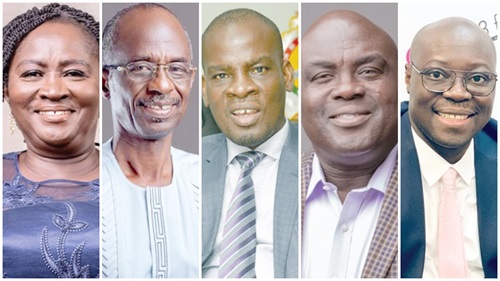
It is a political conundrum confronting the National Democratic Congress (NDC).
President John Dramani Mahama’s second term carries implications not only for the party’s electoral prospects in 2028, but also for its trajectory beyond his presidency.
After an eight-year hiatus, President Mahama returned to office in 2025, having earlier served a first term from 2013 to 2016.
Under constitutional limits, he cannot seek another term.
Yet, curiously, the agitation for a “Third Term” has not entirely subsided.
Part of this sentiment may be driven by the newly enfranchised, unfamiliar with the constitutional ceiling.
Others, impressed by the President’s renewed performance, treat the notion of a third term as a natural extension of success.
More striking is the emergence of this sentiment among sections of the older political class, suggesting that constitutional limits could be tested, stretched, or even amended through “legitimate” processes to meet the demands of the moment.
With the President himself putting the matter to rest—insisting he will abide by the constitutional order—some voices, including members of the Clergy, have urged him to designate a successor who would preserve policy continuity.
Such an arrangement must pass through the NDC’s internal democratic processes, raising a critical question: who among the potential successors is best positioned to leverage President Mahama’s record while assuring continuity in governance?
Vice-President Jane Naana
As Ghana’s first woman Vice-President and the first female Vice-Chancellor of a public university, Prof. Jane Naana Opoku-Agyemang embodies competence beyond symbolism.
Long before assuming office, she partnered President Mahama as his running mate in the 2020 campaign, cementing her role as a trusted custodian of his governing vision.
Her record also includes service as Minister of Education during Mahama’s first term, where she handled one of the government’s most consequential portfolios.
That experience reinforced her standing as a capable administrator and loyal ally.
As the “Third Term” conversation lingers—despite constitutional limits—Prof. Opoku-Agyemang increasingly appears to be the most credible proxy for continuity.
Given her disposition and stage in public life, she is widely perceived as a potential one-term stabiliser, focused on consolidation rather than entrenchment. In a political climate wary of overreach, that restraint could prove decisive.
Johnson Asiedu-Nketiah
Few figures in Ghana’s political history command the institutional memory, authority, and instinct of Johnson Asiedu-Nketiah.
As the longest-serving General Secretary of the Fourth Republic and now chairman of the NDC, he represents the ideological backbone of the party’s tradition.
A trained teacher, Asiedu-Nketiah spent 12 uninterrupted years in Parliament before rising to the apex of party power.
His career—from classroom to legislature to party command—reflects ideological endurance rather than electoral convenience.
His defining legacy lies in steering the NDC through its most punishing years in opposition, reorganising and re-energising the party, and ultimately engineering its return to power after eight bruising years.
Even political opponents acknowledge his discipline and organisational grit.
Yet therein lies the paradox.
If his trajectory resembles the making of a Ghanaian president, then Chairman Asiedu- Nketiah presents the NDC with one of its most formidable puzzles—particularly, persuading him to acquiesce to a quick-fix, one-term, post-Mahama agenda.
Haruna Iddrisu
Haruna Iddrisu is seasoned and structurally grounded in the NDC.
Now Minister of Education, his public service record spans the Ministries of Communications, Trade and Industry, and Employment and Labour Relations—giving him a strong footing in both infrastructure and policy governance.
With more than two decades in Parliament, his legislative career has been far from ornamental, having served as both Majority and Minority Leader.
His rise within the NDC has been organic, building a rare bridge between the old guard and the party’s emerging forces.
Yet political calculus demands realism.
The Vice-President’s entry could blunt his presidential bid, prompting alignment as a possible running mate—an approach that would underscore maturity and a preference for cohesion over ambition.
Julius Debrah and Ato Forson
A Jane Naana Opoku-Agyemang candidacy would almost certainly complicate the presidential calculations of Julius Debrah and Dr Cassiel Ato Forson.
A stalwart of the PNDC tradition, Julius Debrah is a quiet but influential force within the NDC.
His commitment to the party’s ideology is rooted in discipline rather than theatrics.
He could step aside for the Vice-President, calculating that a one-term presidency would reopen the succession question within a manageable time frame.
Ato Forson, by contrast, is the surprise package.
His political stock has risen sharply, buoyed by a rebound in Ghana’s economic indicators that has drawn international attention.
With parliamentary experience on both sides of the aisle—majority, minority; his credentials are substantial.
Still, political arithmetic intrudes.
As fellow Fantes from the Central Region, a direct contest with Jane Naana would be a high-risk gamble.
For Forson, discretion may yet prove the better part of ambition.
Continuity or Contest?
The NDC’s succession debate is less about personalities than strategic direction—whether 2028 should consolidate Mahama’s legacy or serve as the launchpad for a new, long-term governing era.
If the party’s base reflects a desire for continuity, then the best fit for the “Virtual Third Term” sentiment may be Jane Naana Opoku-Agyemang—the safest bridge between Mahama’s administration and the next generational shift.
But politics rarely rewards simplicity.
Ambition, regional balance, generational change, and electoral mathematics will converge to reveal whether the NDC sees the future as an extension of Mahama—or the beginning of something entirely new.
