
Energy reforms yield $15bn: No blackout in 10 months — Energy Minister
Reforms in the energy sector have significantly increased proceeds, enabling the government to pay fully for power generation and related expenditure, the Minister of Energy and Green Transition, John Abdulai Jinapor, has said.
He explained that due to the reforms instituted last year, the Cash Waterfall Mechanism (CWM) from which power producers and fuel suppliers were paid, yielded $15 billion, significantly up from the $6 billion declared into the cash waterfall kitty in 2024.
The minister explained that hitherto, power producers and other suppliers were paid just about 38 per cent of what was due to them, leaving behind mounting debts.
“Through the reforms we took in 2025, we declared $15 billion.
So, from $6 billion, we've taken it to $15 billion, and today, some of the Independent Power Producers (IPPs) are receiving 100 per cent of their invoices,” Mr Jinapor said in Accra yesterday.
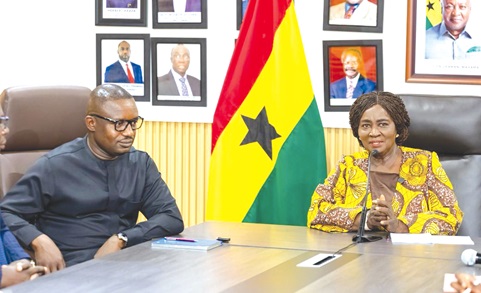
In a presentation on the Energy Sector to the Vice-President, Professor Naana Jane Opoku-Agyemang, who paid a working visit to the ministry yesterday, the Minister of Energy declared: “I can confirm that for about 10 months now, we've not had a single day of load shedding. Not even one day.
We've had consistent delivery of power.”
To help lower the cost of generating power in the country, Mr Jinapor said the government tried to move from using liquid fuel to fire thermal plants to gas, a cheaper source of fuel.
The Energy Minister said that by that arrangement, the country had not imported any diesel fuel since July last year, making significant savings on the about $5 billion spent on liquid fuel imports.
As an alternative, “we've increased our gas consumption by about 70 million metric cubic feet (mmscf) domestically, and another 30mmscf from Nigeria. This has led to real significant changes and savings as far as the sector is concerned,” Mr Jinapor told the Vice-President.
Visit
The visit is part of the familiarisation tours the Vice-President is undertaking to ministries to understand their work and pick up any challenges they face at first hand.
With the Vice-President was the Chief of Staff in her office, Alex Percival Segbefia, and other senior officials.
She was received by the minister, together with management, staff and heads of agencies under the ministry.
Load shedding
Mr Jinapor said the country experienced load shedding every single month from January to December 2024, with the electricity supply deficit reaching as high as 700 megawatts (MW) by December.
“When we took over, we did not have adequate fuel. We had serious challenges with liquid fuel. The sector was further constrained by acute shortages of liquid fuel and mounting debt, which had exceeded $3 billion by March 2025,” he said.
Faced with what he described as a “choking” debt burden, the ministry initiated sweeping structural reforms, beginning with a value-for-money audit of existing contracts.
Mr Jinapor reiterated that at the Electricity Company of Ghana (ECG) alone, 347 contracts were reviewed, leading to the cancellation of 202 contracts valued at $227 million, £1.17 million, and €4 million.
“These were real savings made immediately for the state,” the minister said.
He said a key reform was enforcing strict adherence to the CWM, requiring all sector revenues to be paid into the central account.
That, he said, ended ECG’s practice of weekly bank borrowing to pay Independent Power Producers (IPPs), significantly cutting overdraft and transaction costs.
Mr Jinapor said that through renegotiation of IPP contracts, the government saved an additional $250 million and reduced overall energy sector debt by $500 million.
The Energy Minister said the national electrification supply had now reached nearly 90 per cent, with innovative measures to reduce demands and loads at night.
The moves included the installation of 23,500 solar streetlights to help flatten peak demand by reducing nighttime electricity pressure.
Gas plant
The government had also started the process to construct a second gas processing plant to use indigenous gas for a more reliable electricity supply.
“By the end of the month, the Minister of Finance and I will sign a cabinet memo so we can commence the construction of a second gas processing plant,” the Minister of Energy and Green Transition added.
The Vice-President commended the ministry and encouraged the leadership and staff to explore alternative energy options, including a careful review of past solar energy projects.
Prof. Opoku-Agyemang said she was pleased with the renewed focus on changing the contributors to the country’s energy mix, with emphasis on clean energy.
She underscored the importance of long-term planning, stressing the need to move away from short-term solutions and focus on sustainable strategies that could solve problems effectively.
“We should not be afraid to evaluate, to review, and to re-strategise if some things are not working.
But always be mindful that things can change and that they should change for the better,” the Vice-President said.
Prof. Opoku-Agyemang urged the minister and the agencies to explore safer and easier ways of supplying gas directly to homes.
Support
The Vice-President assured the ministry of the government’s full support, saying the John Dramani Mahama administration was committed to working with the sector to improve the lives of Ghanaians.
Prof. Opoku-Agyemang recalled the intense pressure the government faced after assuming office, particularly upon discovering the true state of the energy sector and the scale of inherited debt.
“We had huge debts. We were threatened with power cuts even before we took over. It was not an amusing situation at all,” she said.
Prof. Opoku-Agyemang commended leaders in the energy sector for stabilising the power supply and steering the country away from an imminent energy crisis, and the President for listening to advice, supporting reforms and working closely with his team to find solutions.
