
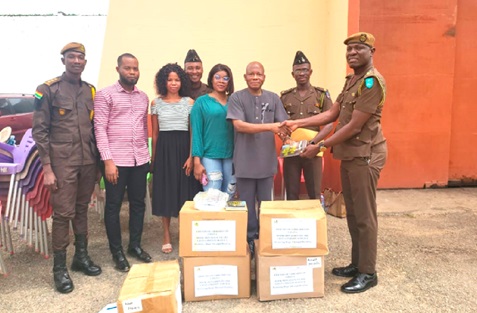
FOLIG collaborates with Ghana Prisons Service
Friends of Libraries in Ghana (FOLIG), a non-governmental organisation committed to promoting literacy and expanding access to educational resources, has initiated a partnership with the Ghana Prisons Service to enhance library services across correctional facilities.
As part of the first phase of this initiative, a FOLIG delegation led by its Founder and Project Lead, Peter Anafo, conducted working visits to the Mamobi Juvenile Correctional Centre and the Nsawam Medium Security Prison.
The visits marked the beginning of efforts to revamp prison library systems and improve learning opportunities for inmates.
During the visit to Nsawam, FOLIG donated a wide range of books, including novels, academic textbooks in fields such as management, social work and calculus, as well as motivational materials and a comprehensive military encyclopedia.
The donation is to support both leisure reading and academic pursuits among inmates.
The team was received by the Officer in Charge, Deputy Director of Prisons (DDP) Patrick Thomas Seidu, and his staff, who also guided the FOLIG team through the facility’s educational units, including the prison library.
Library facility challenges
Assessments at both facilities revealed significant challenges.
The libraries are constrained by poor infrastructure, limited seating capacity, inadequate lighting and ventilation, and outdated, often damaged books that do not meet current educational needs.
Additionally, the absence of a proper cataloguing system makes it difficult for users to locate materials efficiently.
At Nsawam, the library can accommodate only about 12 users at a time and is equipped with just one outdated computer, which did not have essential accessories such as printers and scanners.
Strategic plans for improvement
In response, FOLIG has developed a comprehensive plan to modernise prison libraries through phased interventions.
One key proposal is the transformation of part of the prison’s ICT centre — currently equipped with approximately 20 computers —into a functional e-library to support digital learning and research.
The initiative also prioritises support for inmates enrolled in distance education programmes, particularly those studying with the University of Cape Coast.
The goal is to strengthen their research capabilities, academic writing skills, referencing techniques, and digital literacy.
Education rehabilitation tool
At the Mamobi Juvenile Correctional Centre, FOLIG plans to construct a larger and more conducive library space.
FOLIG emphasises that the initiative is part of a broader mission to transform prison libraries into hubs of learning, rehabilitation, and personal growth.
Prison authorities have welcomed the collaboration, acknowledging that education remains a critical pathway to rehabilitation and reintegration.
DDP Mr Seidu expressed gratitude to FOLIG for its commitment to enhancing opportunities for inmates, particularly those striving to further their education while serving their sentences.
Looking ahead
If successfully implemented, the Nsawam project could serve as a model for similar reforms across correctional facilities nationwide, helping to reposition prisons as centres for transformation rather than mere detention.
