
Foundation demands disability laws enforcement
The Challenged Foundation (TCF) has called for the enforcement of disability laws and demanded accountability from state institutions, service providers and the media.
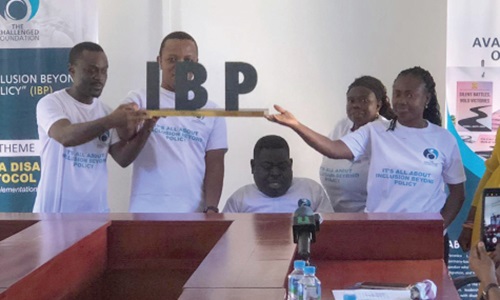
The foundation made the call in Accra last Saturday at the launch of the Inclusion Beyond Policy project (IBP), a national campaign which seeks to remove barriers that exclude persons with disabilities from education, transport, health care and public spaces.
The IBP project also involves holding structured dialogue with policymakers to ensure that disability inclusion in Ghana moves from promise to practice.
The initiative focuses on the African Disability Protocol and Ghana’s Persons with Disabilities Act 715, which the foundation’s advocates said had not delivered meaningful change due to the lack of implementation and enforcement.
The Challenged Foundation also announced a national petition aimed at urging government agencies and public institutions to meet their legal obligations and bridge the gap between existing legal frameworks and the lived experiences of persons with disabilities.
The foundation is a Ghanaian non-governmental organisation dedicated to amplifying the voices of persons with disabilities in society.
Action
The Executive Director of Women with Disability Development and Advocacy Organisation (WODAO), Veronica Kofiedu, who launched the project, said Ghana needed to shift from symbolic inclusion to practical change.
“For far too long, persons with disabilities have watched policies being written, and conventions being ratified, while everyday realities remain unchanged. Rights on paper do not automatically translate into rights in practice,” she said.
Ms Kofiedu said the project aligned with disability-led advocacy and accountability.
“Advocacy is not noise. Advocacy is organised truth-telling. When it is led by persons with disabilities themselves, it becomes impossible to ignore,” Kofiedu said.
Enforcement, accountability
For his part, a member of TCF, Ella Ametor, stated that the petition aimed to empower citizens to demand enforcement and measurable outcomes, rather than sympathy.
“This petition is not about charity. It is about dignity, access and justice. Policies exist, laws exist, and international commitments exist, yet persons with disabilities continue to face barriers in education, health, transport, public space and decision-making,” he said.
Mr Ametor added that weak enforcement continued to undermine disability inclusion despite existing legal commitments.
“Without accountability, inclusion remains symbolic and ineffective. Government bodies, public institutions and service providers must be held responsible to fulfil their legal obligations,” he said.
Media urged to act
Another representative of TCF, Selasie Sikanku, stated that the campaign would engage communities and train journalists and social media content creators on how to address disability issues effectively, rather than reinforcing harmful stereotypes.
Mr Sikanku also criticised media houses, and said songs, films and news coverage often portrayed persons with disabilities as weak and pitiful.
“The lives of persons with disabilities are not bound to the wheelchair or the white cane. Those are tools that make life easier, not symbols of weakness,” he said.
