
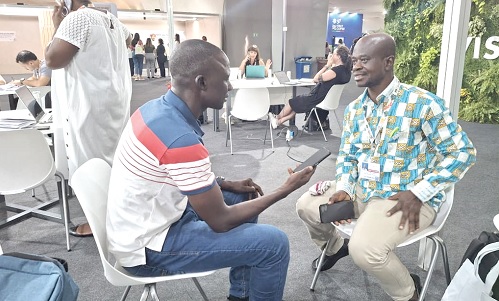
Ghana makes history at COP30 - Dr Amoah chairs Africa Group of Negotiators
The 30th Conference of the Parties (COP30) ended in the Brazilian city of Belem, with Ghana given the mantle to lead the African Group of Negotiators (AGN) in climate negotiations for the next two years.
The Director in charge of Climate Vulnerability and Adaptation at the Climate Change Department of the Environmental Protection Authority (EPA), Dr Amoah, made history as the first-ever Ghanaian to lead the regional bloc as its Chairman.
His tenure of office runs from January 1, 2026, to December 31, 2027.
Within the two years, Dr Amoah would provide strategic leadership and vision to the African continent in matters relating to climate change and sustainable development.
The AGN
The AGN is one of the strongest negotiation bodies within the UNFCC process that represents the African voice in the negotiation rooms.
The structure of the AGN is such that it has the chair: the national focal persons who represent the UNFCCC in their countries; there are lead coordinators who follow the thematic areas during negotiations; and the last layer of the structure is the political, which has the president, ministers and the technical level.
The Chairmanship of the AGN is rotational every two years across the five subregions in Africa - Western, Eastern, Northern, Southern, and Central Africa. Tanzania is currently chairing the AGN, with the tenure expected to end on December 31 this year.
Vision
In an interview with the Daily Graphic at Belem in Brazil during the COP, Dr Amoah described the feat as historic and monumental for Ghana.
"For us as a country, it is a monumental feat because the last time it came to West Africa 10 years ago, it was chaired by Mali, but this time we are chairing it. This is the first time Ghana is chairing the AGN, so for us, it is historic; and I am also happy that it is I who has been given that opportunity.
He added that the mantle of leadership that had landed on him was a great opportunity to project the image and interest of the continent in the negotiation rooms, not only in climate change but other international fora.
The seasoned negotiator said climate change was a developmental issue, so his chairmanship would seek to understand the complexities and project the interests of Africa in many ways.
For instance, he said the issue of critical or transitional minerals would be one of the focus areas for the two years of his chairmanship. He said critical minerals played a major role in the just transition that was dominating climate change discussions.
"Data suggests that Africa alone hosts 30 per cent of the global critical minerals.
We need to ensure that countries are well informed, have the needed strategies, and the needed capacity to play our roles well in the transition so that Africa can take its place in the transition using these minerals," he said.
Capacity building
Dr Amoah also said building the capacity of the youth in climate change negotiations would be a key area of focus under his leadership.
He said Africa had very vibrant and energetic youth whose potential could be properly harnessed and channelled into mainstream negotiations at COPs.
"Since the youth is our future, we need to make sure that those of us who have the experience nurture them and give them the opportunity today to actively engage in negotiations so that they can gain expertise," he said.
Again, he said gender issues would be top of the agenda for him since women play a key role in development.
"We need to empower them and build their capacity to negotiate well so that their voices can be heard," he said.
He added that under his leadership of the AGN, systems would be put in place to bridge the gap between the political and technical levels as far as the negotiations were concerned.
