
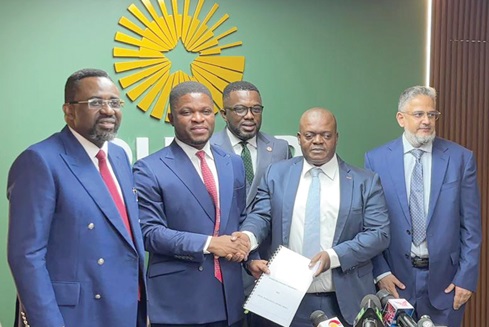
GoldBod signs agreement with Royal Ghana Refinery to maximise minerals value
The Ghana Gold Board (GoldBod) has signed a refinery agreement with Royal Ghana Gold Refinery to refine gold locally in a major step towards maximising the value of minerals produced locally.
Under the agreement, GoldBod will supply up to one tonne of gold every week for local refining.
It forms part of the government’s broader mineral value-addition agenda.
It also marks GoldBod’s second major refinery partnership in 2026, following an earlier agreement with Gold Coast Refinery.
Background
About a month ago, the Chief Executive Officer (CEO) of GoldBod, Sammy Gyamfi, toured the Royal Ghana Gold Refinery, in which the Bank of Ghana holds a majority stake, as part of ongoing processes towards the signing of the agreement.
The visit formed part of GoldBod’s broader strategy to support the local value addition and ensure that the country derives greater economic benefit from its mineral resources through in-country refining.
Commitment
Speaking at the signing ceremony in Accra yesterday, the CEO of GoldBod reaffirmed President John Dramani Mahama’s commitment to ensuring that by 2030, all mineral resources mined in Ghana would be refined locally before export.
"His Excellency has boldly announced his vision to bring an end to the export of raw minerals by the year 2030, and we have been given the mandate to lead that process," he said.
Mr Gyamfi further stressed that GoldBod had been tasked with leading the government's strategy to end raw mineral exports before the end of the decade.
"Our marching orders from His Excellency the President have been very clear from day one: we must change the narrative of Ghana's continuous export of raw minerals," he said.
According to him, Ghana previously lacked the capacity to refine its own gold.
"When we took office on January 7, 2025, Ghana did not have the capacity to refine gold locally. All gold produced from both the large-scale and small-scale sectors was exported in their raw state," Mr Gyamfi said.
The GoldBod CEO described the situation as unacceptable for a country globally recognised for its gold production.
"It is a tragedy that as a mining nation, we did not possess the capacity to refine the minerals we produce locally to ensure value addition and local value retention," he added.
He, therefore, gave an assurance that local refinery services would curb purity losses associated with refining gold outside the country.
According to him, the agreement was expected to help Ghana to retain refining fees, recover valuable by-products, create jobs and strengthen the country’s position as a leading gold refining hub in Africa.
Improvement
The Governor of the Bank of Ghana (BoG), Dr Johnson Asiama, said there would be a significant improvement in the country’s balance of payments if it undertakes value addition of its natural resources.
Dr Asiama added that not only gold but the processing of all natural resources, including oil and cocoa, were long overdue for value addition.
He said value addition offered enormous benefits in job creation and higher revenue, among other benefits.
The Governor commended the partnership and reaffirmed the central bank’s support for the initiative.
Dr Asiama confirmed that BoG held a minority stake in Royal Ghana Gold Refinery Limited, explaining that the investment was primarily intended to strengthen regulatory oversight and support Ghana’s broader gold value addition agenda.
Appreciation
The CEO of the Royal Ghana Gold Refinery Limited, Eric Frimpong, said the refinery would align with the government’s 24-hour economy programme to generate more job opportunities.
He expressed appreciation to President Mahama, Finance Minister, Dr Cassiel Ato Forson, the BoG and GoldBod for their support and confidence in the refinery.
Mr Frimpong confirmed that the refinery possessed the technical capacity, modern equipment and the human resources required to operate continuously to maximise refining output and support Ghana’s industrial transformation agenda.
He also disclosed the company’s long-term ambition to attain London Bullion Market Association (LBMA) accreditation and position Ghana competitively within the global refining industry.
