
The government has announced plans to develop 1.5 gigawatts of solar-hydropower generation capacity with battery energy storage systems at Buipe in the Savannah Region.
The project is expected to provide cheaper, cleaner and more reliable electricity for industries operating under the 24-Hour Economy programme.
The first phase of the project, which consists of a 100-megawatt solar power plant with battery storage, is scheduled to commence next year, with subsequent phases to be rolled out progressively until the full 1.5-gigawatt target is achieved.
The initiative is designed to ensure a stable electricity supply for manufacturing, agro-processing and other energy-intensive industries that operate around the clock, while reducing dependence on expensive conventional power sources.
At the opening of the seventh Ghana Investment and Trade Week Show in Accra yesterday, Presidential Advisor on the 24-Hour Economy, Augustus Goosie Tanoh, said the project, when completed, would lower industrial electricity tariffs from the current 18 to 23 United States cents per kilowatt-hour to between 7 and 9 cents per kilowatt-hour.
"The anticipated reduction in energy costs is expected to significantly improve the competitiveness of Ghanaian manufacturers, lower production costs, attract new investments and create more jobs by making locally produced goods more competitive in both domestic and international markets," he said.
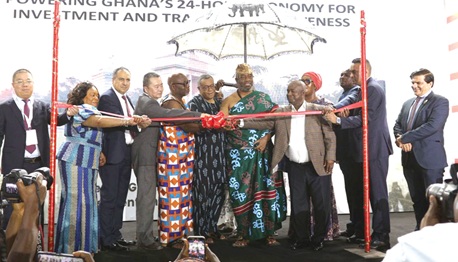
The Ghana Invest and Trade Week 2026 (GITW 2026) is aimed at positioning Ghana as the country's premier platform for investment, trade, innovation and strategic collaboration.
On the theme, "Powering Ghana's 24-hour economy for investment and trade competitiveness," the three-day event ends tomorrow.
It features exhibitions, investment fora, business matchmaking sessions and strategic discussions expected to generate partnerships that will support Ghana’s industrialisation and economic transformation agenda.
The opening was attended by personalities such as the Ga Mantse, Tackie Teiko Tsuru II; the Chief Executive Officer (CEO) of the Ghana Free Zones Authority (GFZA), Dr Mary Awusi; Chairman of the Ghana Chamber of Construction Industry (GCCI), Nana Opare Kwafo I; Vice-President in charge of Strategy and Partnership at the MIE Group, Zahoor Ahmed, and other dignitaries.
It was organised by MIE Events, in collaboration with Africa Build Show, MEGAWATT Africa and other partners.
Driving industrial growth
Mr Tanoh said the government had already signed a joint development agreement for the project on April 10, 2026, describing it as a major step towards transforming Ghana's energy sector.
“Closing that gap does more for the competitiveness of Ghanaian industry than any other single incentive,” he said in reference to the difference between current industrial electricity tariffs and projected renewable energy costs.
He said cheaper and more reliable power could help increase manufacturing's contribution to Ghana's Gross Domestic Product from the current level of about 10 per cent to 20 per cent.
He added that the renewable energy programme formed part of broader efforts under the 24-Hour Economy initiative to attract investment, expand exports and create sustainable jobs across the country.
Mr Tanoh said the government had begun aggregating electricity demand from industrial parks, inland ports and logistics hubs to provide investors with guaranteed off-take arrangements for power generation projects.
He stated that renewable energy would also support the development of electric buses and trucks, affordable housing and agro-industrial parks along the proposed Volta Economic Corridor.
He said the government was inviting local and international investors, development finance institutions and pension funds to finance the projects, adding that the programme had been structured to reduce investment risks and ensure long-term commercial viability.
Mr Ahmed said the summit was established to encourage foreign direct investment into Ghana while supporting the country’s broader economic transformation agenda, particularly the government’s 24-Hour Economy initiative.
He explained that the summit focused on key sectors that aligned with Ghana’s growth priorities, including energy, construction, electric mobility, transportation, smart cities and sustainable infrastructure.
"The goal is to expose international companies to investment opportunities in Ghana and encourage partnerships that can lead to the establishment of factories and expansion of industrial capacity," he said.
Mr Ahmed added that Ghana’s position as a trade hub and gateway to West Africa gave it a competitive advantage, saying, “MIE Group’s 10 years of experience operating in the country has provided the organisation with a strong understanding of the opportunities available across different sectors.”
Advantage
The Ga Mantse, Tackie Teiko Tsuru II, who chaired the opening ceremony, urged investors to take advantage of Ghana’s peaceful environment, political stability and investment potential.
He stressed that collaboration between traditional authorities, the government and the private sector remained essential in creating sustainable opportunities for economic growth.
