Let’s increase investment in rice sector - Vice-President urges West African countries
The Vice-President, Professor Naana Jane Opoku-Agyemang, has called for increased investment in rice production and value addition across West Africa to reduce the region's dependence on imports and strengthen food security.
She said although West Africa possessed vast agricultural resources, entrepreneurial farmers and growing consumer markets, it continued to spend huge amounts of money annually on food imports, with rice accounting for a significant share of the import bill.
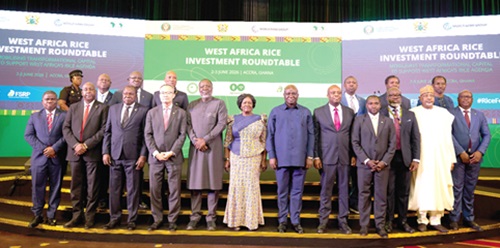
Prof. Opoku-Agyemang made the call at a West Africa Rice Investment Roundtable in Accra yesterday on the theme: "Mobilising transformational capital to support West Africa's rice agenda."
Food security
The Vice-President said food security had become a strategic issue that transcended agriculture, and was now closely linked to macroeconomic stability, social protection, national security and geopolitical independence.
"Countries that import too much food also import vulnerability," she said, adding that recent climate shocks, export restrictions and geopolitical tensions had exposed weaknesses in global food systems.
"West Africa must, therefore, see rice as a strategic economic asset. It is about jobs for our young people, incomes for farmers and strengthening the resilience of our economies against future global shocks," she said.
Prof. Opoku-Agyemang, therefore, said that governments, development financial institutions and the private sector must work together to mobilise blended finance and long-term investment to support agricultural transformation.
Ghana’s deficit
The Minister of Food and Agriculture, Eric Opoku, said the country consumes about 1.7 million tonnes of rice annually, but produced about 960,000 tonnes, leaving a deficit of approximately 751,000 tonnes.
He said the country also spent about $320 million annually importing rice to meet domestic demand.
Mr Opoku announced measures aimed at achieving rice self-sufficiency within the next 10 years.
He said the government had undertaken advanced satellite-based mapping of rice-growing areas across the country to identify investment opportunities and support decision-making.
"We are no longer offering vague potential, we are offering verified, location-specific, monitorable opportunities," the minister said.
Unlocking potential
The Deputy Minister of Finance, Thomas Nyarko Ampem, said West Africa must move beyond discussions and focus on mobilising investment to unlock the full potential of the rice sector.
He said the region continued to spend between $3 billion and $4 billion annually importing rice despite having the resources to produce more locally.
"Therefore, the real jollof competition before us is not whose rice tastes better. It is whether West Africa can finally produce enough rice to feed itself competitively.
"West Africa does not need more declarations. We need to create pipelines of bankable projects capable of crowding in long-term capital at scale.
"The time for talking about West Africa's rice potential is over. The time for financing it is now," Mr Ampem said.
Initiatives
The President of the ECOWAS Commission, Dr Omar Alieu Touray, also said that although regional rice production increased by 44 per cent between 2008, and 2024, it still met only about 60 per cent of demand, leaving West Africa heavily dependent on imports.
He said ECOWAS had developed some initiatives, including the Rice Offensive Programme and the Regional Rice Roadmap 2025-2035, to accelerate progress towards rice self-sufficiency.
Dr Touray added that member states had also developed National Rice Investment Action Plans and pipelines of bankable projects to attract investment to the sector.
"Within this challenge lies a significant opportunity — an opportunity to boost domestic production, strengthen regional markets, attract investment and accelerate agri-food systems transformation," he said.