
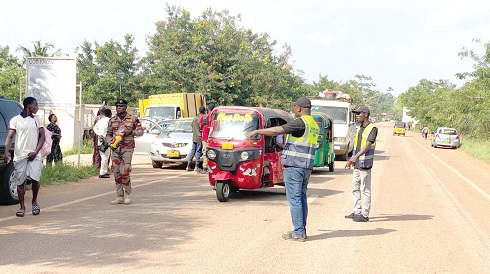
NRSA cautions drivers to adhere to speed limits
The Director-General of the National Road Safety Authority (NRSA), Abraham Amaliba, has cautioned drivers to drive within speed limits specified in the Road Traffic Regulations (L.I 2180) to reduce carnage on the country’s roads.
Mr Amaliba further stressed the need for drivers to strictly adhere to the mandatory 30-minute rest after every four hours of driving to help curb crashes.
In an interview with the Daily Graphic yesterday, the NRSA director-general emphasised that drivers must desist from driving for more than eight hours in a day to prevent fatigue, which had been identified as one of the main causes of road crashes.
“Drivers must also refrain from alcohol and drug use while driving, regularly maintain their vehicles and ensure full compliance with road traffic regulations,” he said.
The interview took place at the climax of a one-week special operation conducted by the NRSA and personnel from the Motor Traffic and Transport Division (MTTD) of the Ghana Police Service to help reduce road crashes during the Easter festivities.
Context
As contained in L.I 2180, Speed limits are classified based on the type of road and the location, rather than strictly by "private vs commercial" status, although specific, stricter limits apply to commercial heavy vehicles.
The general speed limits for private and commercial vehicles are 30 km/h in residential areas, schools, churches, and markets; 50 km/h in urban/built-up areas; 90 km/h on highways (outside built-up areas); and 100 km/h on motorways.
For loaded commercial trucks, the law requires drivers to travel at 75 km/h, while unloaded trucks can go up to 80 km/h.
Easter operations
The joint sensitisation and enforcement exercise on some key highways was carried out on major risk-prone road corridors, including Accra–Suhum–Bunsu, Accra–Aburi–Mampong, Accra–Aflao, Accra–Akosombo, Accra–Cape Coast and Kumasi–Tamale.
The 2026 Easter Road Safety Campaign aimed to reduce road traffic crashes during the festive period.
The campaign was targeted at addressing high-risk behaviours such as speeding, driving under the influence of alcohol and drugs, fatigue driving over long distances, as well as distracted driving - mobile phone use.
It was grounded on research by the NRSA, which established that road traffic crashes increased during festive periods due to heightened vehicular and human movement.
The Easter season, often associated with long-distance travel and social gatherings, posed additional risks, especially as some drivers engaged in alcohol consumption, extended driving and other unsafe practices.
Sustained campaign
Mr Amaliba stated that beyond enforcing road traffic regulations on highways, the NRSA had intensified public education programmes and community engagement to rally all stakeholders to ensure road safety.
He added that the authority was increasing church and mosque sensitisation activities to reach large congregations, alongside school outreach programmes to build early road safety awareness among children.
