
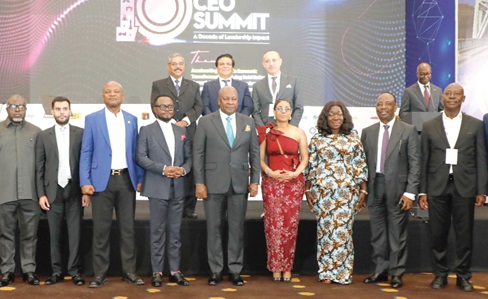
President launches CEO Government Compact 2026
President John Dramani Mahama has launched the CEO Government Compact 2026, a framework designed to move the relationship between the state and the private sector from ceremonial engagements to a structured, accountable partnership focused on delivering measurable results.
He subsequently handed over the document to the Minister of Trade, Agribusiness and Industry, Elizabeth Ofosu-Adjare.
The document would later be sent to the Attorney-General’s Department for review, followed by engagement with the CEO Network for finalisation.
The President launched the framework at the 10th Ghana CEO Summit and Expo in Accra yesterday, on the theme: “Accelerating Ghana’s economic transformation: Driving bold reforms through leadership, technology, and industrialisation for sustainable growth.”
The event, which marked the 10th anniversary of the CEO Network, brought together captains of industry, business leaders, and state officials, including the Minister of Trade, Agribusiness and Industry, the Commissioner-General, Ghana Revenue Authority, Anthony Kwasi Sarpong, and the Governor of the Bank of Ghana, Dr Johnson Pandit Asiama.
The event was chaired by Togbe Afede XIV.
Economic stability
President Mahama said the recently completed extended credit facility programme with the IMF and the agreement to undertake a Policy Coordination Instrument (PCI) would further stabilise the economy for accelerated development.
“We have spent considerable time discussing economic recovery, stability, and national reset. These are necessary foundations, but are not enough on their own.
“Stability must underpin production; production must create jobs; jobs must raise incomes, and higher incomes must restore confidence and dignity among our people.
“Economic transformation must be defined by how it improves the daily lives of citizens, not just by statistics,” he said.
24-hour economy
The President further clarified the 24-Hour Economy initiative, saying the concept was not simply about asking people to work at night, but utilising their productive capacities more efficiently.
He disclosed that following the establishment of the 24-Hour Economy Authority, a team had presented a comprehensive plan for the country’s economic transformation over the next 10 years to cabinet.
It included making power cheaper for industry, improving the logistics value chain, delineating industrial and agro-processing parks, and providing exemptions and incentives for industry to prosper.
President Mahama said the next summit must be structured - from general dialogue to concrete commitments, and from those commitments to measurable outcomes, reflected in investments, exports, industrial growth and jobs.
Financial sector reforms
Dr Asiama called for bold leadership, innovation, and stronger policy coordination to drive the country’s economic transformation, saying that macroeconomic stability alone would not guarantee long-term prosperity.
Speaking on the theme, “Managing financial sector reforms and industrial growth: Driving Ghana’s economic transformation from vision to action,” he said the country stood at a critical stage where it must convert its recent economic recovery into sustained industrial growth and inclusive development.
Dr Asiama said the recovery from global shocks and domestic economic challenges presented an opportunity for deeper reforms and stronger institutional resilience.
Private sector
For her part, Mrs Ofosu-Adjare said the private sector was not optional but essential to the government’s transformation agenda.
She commended the CEO Network for sustaining the summit platform for 10 years, adding that the nation’s transformation would not come from exporting raw materials and importing finished goods at a higher cost.
She therefore said the government had taken action through the establishment of bold initiatives such as the Feed the Industry Programme, which directly connected agricultural production to industrial demand.
“These deliberate policy choices are already beginning to shift the structure of our economy,” the minister said.
