
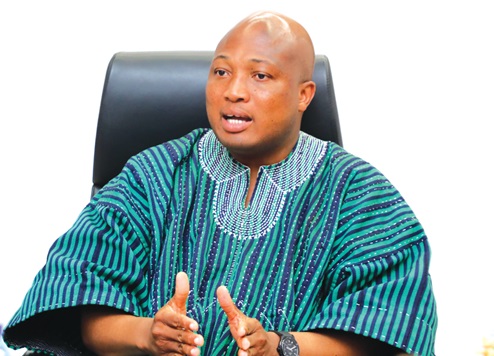
The proactive and consistent statements on grave global issues by government is not a shift from the country’s foreign policy direction, the Minister of Foreign Affairs, Samuel Okudzeto Ablakwa, has said.
He explained that the country had always taken a consistent foreign policy direction no matter the regime, guided by principles such as respect for the United Nations (UN) Charter, international law, rule-based order, Pan-Africanism, good neighbourliness, among others.
Mr Ablakwa, who spoke to the Daily Graphic exclusively last Friday, expressed commitment to those principles, citing examples on recent developments which were condemned by past and present governments.
“When Russia invaded Ukraine, the previous government issued a statement and boldly condemned that invasion because it was an attack on sovereignty.
It was against the rule-based order and it was a violation of international law.
“At the time, we were also serving on the UN Security Council.
So, there was high expectation that Ghana would speak out and take a position.
That same principle is what we espoused recently when President Trump went into Venezuela uninvited and, as it were, abducted President Nicolas Maduro and his wife,” he said.
Also, on the Palestinians and Israelis, the Foreign Affairs Minister said that was consistent with the country’s principles; anytime there was an encroachment against the 1948 UN Resolution, the country spoke out since its First Republic led by the country’s founder and first President, Dr Kwame Nkrumah.
Mr Ablakwa added that particularly for relatively small countries, and countries that did not want to spend taxpayer resources excessively on building military might and nuclear weapons, it was necessary that they spoke out on issues.
He asserted that perhaps the recent articulation with clarity on grave global issues had prompted a realisation from Ghanaians, but it should not be equated to a shift from the country’s foreign policy.
Ghana’s voice
The Foreign Affairs Minister said the country had maintained its outspoken stance on global issues, prioritising peace, sovereignty and international cooperation, as the country had been a top UN troop-contributing nation since 1960 and recently ratified the treaty against nuclear weapons proliferation.
“As a country, since the days of the Osagyefo, Dr Kwame Nkrumah, we have not been a country that chooses silence.
“It’s important to note that when you are in a global community and you have all agreed to certain rules and norms, any time there is a violation, a deviation and you choose silence, those who are being oppressed don't appreciate your silence.
They will take it as an endorsement of what they are going through,” he said.
By voicing consistently, Mr Ablakwa said the country had earned its recognition as a champion of peace and cooperation, adding that it was instrumental in protecting the country’s sovereignty, and ensuring that when next it was the victim, others would speak out for it.
The minister stressed that the country's voice mattered in global affairs, and it would continue to advocate principles that promoted a more just and peaceful world.
Rationale
Mr Ablakwa underscored the country’s leadership in global affairs and its rooted history of pan-Africanism and its commitment to fighting colonialism and imperialism.
He indicated that with the country's influence in training African freedom fighters during the struggles for independence, it would amount to betrayal of its principle if it maintained silence in the face of actions it abhorred in the past.
Th Foreign Affairs Minister added that the country’s Non-Aligned Movement and its vocal advocacy for international law and sovereignty were historically identical to its historical significance as the first sub-Saharan nation to gain independence and influence on the continent.
Mr Ablakwa affirmed that the country had always made significant contributions in international relations, producing notable leaders such as the first black African President of the UN General Assembly, Dr Alexander Quaison-Sackey, and the first black African UN Secretary-General, Kofi Annan.
He added that Ghana would continue to ensure that it was heard for the right reasons as part of its principles.
